4.5. Evaluation of Outline Solutions
The Authority and its advisers should assess through detailed evaluation and where appropriate clarification, whether the bidder's technical design solutions have the ability to meet the performance obligations as set out in the Output Specification. Sometimes bidders will acknowledge that their solution cannot meet all the Performance Standards and request a change to the Output Specification. The absence of such a request should not be taken to provide comfort that the solution will meet the Output Specification. Whilst the financial risks of non performance of the technology will fall to the Contractor it is not in the Authority’s interest to procure a solution that has a low probability of meeting the Output Specification. Additionally, the Authority and its advisers should ask for the funder’s knowledge of, and experience of funding, the technology and their plans in relation to technical due diligence.
Detailed critical assessment is required, by suitably qualified and experienced advisers, on the likely performance of the technology proposed and the risk that the solution may not meet the Performance Standards in the Output Specification. If a bidder’s technology choice generates certain risks e.g. in relation to disposal of residues then the bidder should take responsibility/liability for such risks.
The evaluation process should include a detailed review of the:
• Ability of the technology to deal with the Contract Waste characteristics, flexibility in operations for fluctuations in waste tonnage and composition;
• Operating limits which the Contractor will wish agreed and built into the Contract;
• Maintenance regime of the plant and the levels of redundancy and modularisation to ensure continuity of service;
• Products and residues generated by the process;
• Ability of the plant throughput to be enhanced or expanded to meet changing Contract Waste tonnages;
• Likelihood to achieve necessary consents and planning permission;
• Commissioning and testing regime as part of the Acceptance Test; and
• Bidders’ proposals for RWTF capacity, for more details please refer to the paragraph below.
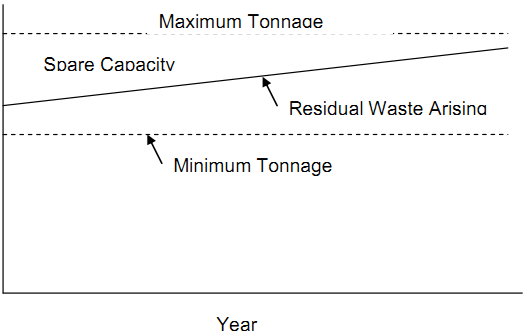
In line with the waste hierarchy the preference must be to treat residual waste, prior to landfill disposal. In determining the residual waste treatment capacity, the Authority will have to be mindful of the commercial requirement to agree with the Contractor the minimum and maximum range of tonnages required to be treated. The minimum level should be set such that it is consistent with the Authority’s and the Government’s reduction and recycling targets. The maximum level should take account of higher than anticipated growth rates, the availability of alternative facilities and provide the Authority with some flexibility should its recycling targets not be met. The Authority will need to model a range of sensitivities around these factors (growth in waste arising, recycling levels and requirements relating to commercial and industrial waste) in order to determine the RWTF capacity.
The figure below illustrates graphically the various interrelationships.
Notes:
1. The residual waste arising should reflect WS 2007 targets i.e. the achievement of 50% recycling by 2020 and reduction in household waste not re-used, reduced or composted to 225 kg/household.
2. The minimum tonnage should be set at a level that is consistent with the achievement of future reduction and recycling targets. It may be a flat line target or profiled over time to reflect anticipated changes in Contract Waste.
3. The maximum tonnage may equate to the capacity of the RWTF. However, Authorities should consider the possibility that bidders may propose a greater capacity in anticipation of securing third party revenue.
4. The spare capacity in the early years may be made available for Third Party Waste. The Contract should make it clear whether the Authority has first call on any spare capacity should the residual waste arising be greater than forecast. Authorities should be aware that there is a trade off between its interest in having preferential rights to such capacity and the Contractor’s interest in maximising revenue from third party waste. Commercial and industrial waste contracts typically run for one to two years hence there will also be a timing issue where capacity is switched from third party use to Authority waste.