1. Introduction and Scope
The Value for Money ("VfM") guidance requires the use of quantitative appraisal throughout the VfM assessment stages (the Programme Level, Project Level and Procurement Level). The quantitative assessment should compare the financial cost of the chosen procurement route with a suitable comparator. This requirement should apply regardless of the procurement route chosen as a comparative analysis will almost always be possible.
VfM guidance requires quantitative assessment, using a risk adjusted Conventional Procurement Assessment Model ("CPAM") as an economic comparator against a shadow bid financial model (a proxy private finance structure). The shadow bid model will typically be developed by Procuring Authorities in conjunction with their appointed financial advisers to facilitate both the VfM and affordability assessments. The shadow bid model will produce an indicative Unitary Charge. This Unitary Charge will be used as a proxy of the expected annual cost of a privately financed / NPD project. The discounted unitary charge over the life of the project will be compared to the discounted cost of the CPAM to provide an indication of the quantitative VfM assessment of the project.
At the Project and Procurement Levels, the purpose of the CPAM is to provide a benchmark against which to form a judgement on the likely quantitative Value for Money position of a privately financed / NPD procurement route which is a distinct task, separate from affordability analysis. There is no reason to presume that a good Value for Money project will be affordable or that an affordable project will represent good Value for Money. The issue of Affordability is not covered by this note.
The evaluation model will assist Procuring Authorities (Local Authorities, NHS Scotland Organisations, Scottish Government Agencies and Directorates) to help ensure that best value is achieved, and provide an audit trail of the VfM implications of a project throughout the procurement process. This exercise is intended to supplement the qualitative VfM elements and should be reviewed throughout the procurement process at the same stages.
Figure 1: Summary of Value for Money Quantitative Assessment
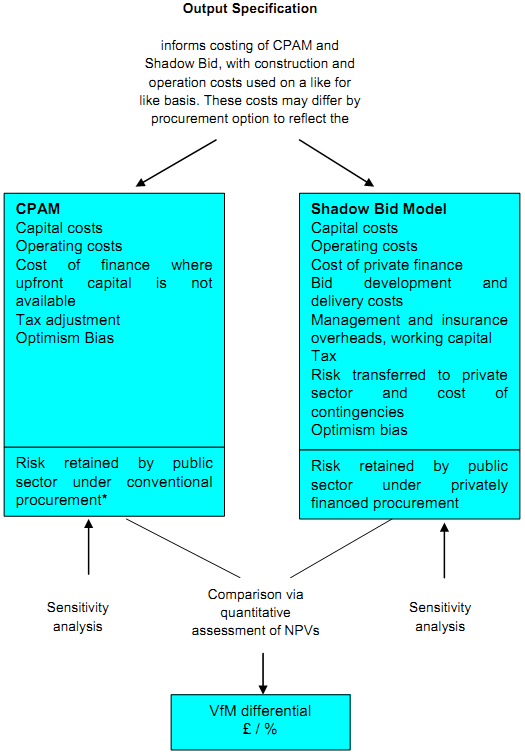
* Where the Authority proceeds with a conventional procurement, under which the programme / project risk is to be retained by the public sector, the Authority should refer to the Construction Advice and Policy Division's (CPAD's) Construction Procurement Manual: http://www.scotland.gov.uk/Publications/2005/11/28100404/04045
Where the difference in the assessments of the conventional option and the privately financed option are marginal (small positive for or against) the outcome should not be interpreted as sufficient evidence for or against the use of private finance as a procurement route. In such cases more weight should be given to the qualitative rather than the quantitative assessment.
This note provides guidance on the quantitative VfM assessment and provides detail on the models which facilitate quantitative comparison for VfM purposes.
This note also discusses the inclusion of risk and Optimism Bias in the quantitative assessment, looking at how these areas are expected to be developed and valued.