The Current State of Privatization
|
| The Current State of Privatization |
Though rare only a decade ago, road privatization has become increasingly common in the United States. Currently 24 states and Puerto Rico have legislation or regulations authorizing the use of public-private partnerships in highway construction and operation.7
As of the end of 2008, 15 roads had been privatized, and approximately 79 roads were either in the process of being built by private entities or being considered for privatization. (See "Tallying Up the Number of Privatization Projects.") This privatization activity represents a substantial amount of money: from 1994 to early 2006, $21 billion was paid during this time period for 43 highway facilities in the United States using various models (including models other than those considered in this report).8 These numbers may rise as more states attempt to overcome severe short-term budget deficits and meet unfunded transportation needs.9
| Tallying Up the Number of Privatization Projects In counting the number of privatization projects across the United States, we attempted to be as inclusive as possible, including projects at every stage of consideration from idle discussion to full-fledged proposals. Information about privatization proposals was gleaned from a variety of sources, which are described in detail in Appendices B and C to this report, which can be downloaded from www.uspirg.org/road-appendix. The privatization field is extremely fluid. Some proposed projects may have been dropped; others may have been put on hold. New projects may also have been proposed since the research for this paper was completed. Moreover, some proposals, particularly at the early stages, are vague about the role of private investment and involvement. In other words, the number of privatization projects described here represents a snapshot in time and a relatively broad view of what constitutes a privatization project. |
Figure 1. Privatization Projects Completed, Underway or Proposed, by State
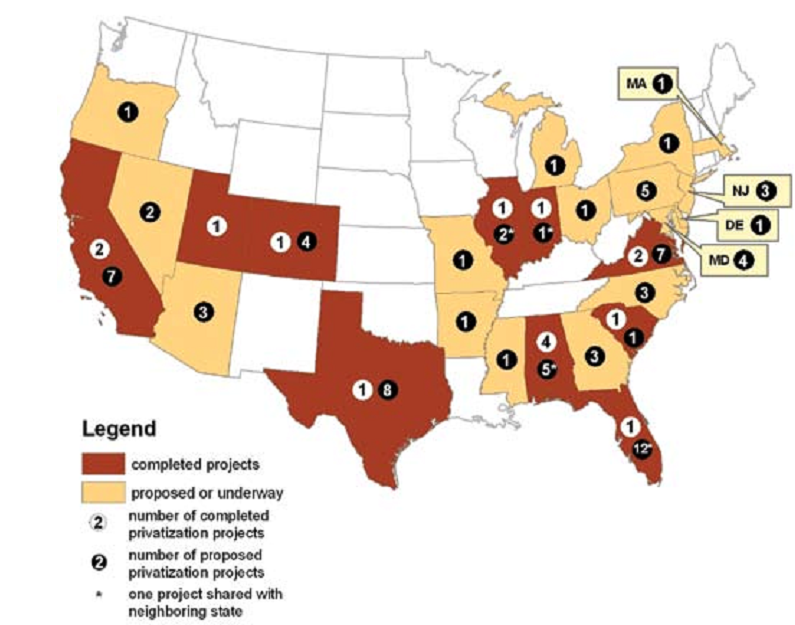
For a detailed listing of completed and proposed privatization projects by state, please download Appendices B and C of this report, available at www.uspirg.org/road-appendix.
Common in the less-developed world for the last couple of decades, infrastructure privatization had not taken root in the United States until recently.10 During the 1990s, infrastructure privatization became increasingly popular in East Asia and in Latin America, where Enron was a major investor. In those countries, unlike in the United States, access to long-term capital was a major problem for governments seeking to build infrastructure. According to World Bank records, infrastructure privatization outside of the United States reached a peak of over $110 billion per year in 1997 and 1998.11
Many infrastructure privatization deals became high-profile failures. Two dozen private toll roads went bankrupt in Mexico after 1994. The Thai government seized one railroad that had been in private hands in 1993. Britain renationalized its rail sys-tem from Railtrack, the private company that had purchased the rail system, in 2001.12 A World Bank study of over 1,000 infrastructure projects in Latin America and the Caribbean between 1982 and 2000 found that 55 percent of privatization contracts in transportation and 75 percent in water and sewer had been renegotiated, most during the first few years.13 Twenty-one toll road projects in Hungary, Indonesia, Mexico, and Thailand were subsequently taken over by the government.14 By the early years of the current decade, the volume of privatization deals had returned to the lower levels of the early 1990s.