Lack of Transparency
|
| Lack of Transparency |

Given the profound implications of road privatization, no deal should be approved if the public has not had the opportunity to review, question and comment upon it. Unfortunately though, many states lack legislation requiring transparency in private road projects, such as making proposals available to affected communities. This refusal to provide information is justified on the basis that private road builders and operators regard their own analysis and proposals as "proprietary" business secrets. But such rules prevent full public review of the process and undermine both transparency and the opportunity for full public participation.98 The Indiana and Chicago leasing deals were finalized with very little public deliberation or oversight. Texas would have lost billions of dollars in revenue if public hearings had not exposed the higher payoff that could be offered by the public authority. The Florida Department of Transportation is actually exempt from undergoing review of its privatization con-tracts by the Florida Council on Efficient Governments, a council created to review state contracts with private operators. Full transparency requires the public to have a meaningful opportunity to participate in public hearings plus timely disclosure of a potential deal's terms and any related contracts and subcontracts well before a decision is made.
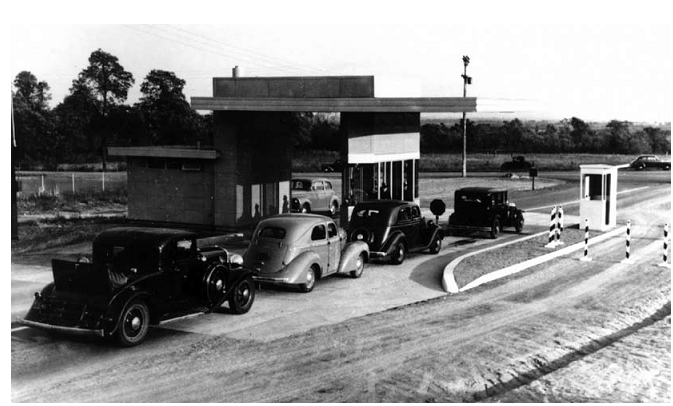
Cars lining up for the opening of the Pennsylvania Turnpike in 1940 (Photo: Pennsylvania
Turnpike Commission).
| Strong Public Opposition to Road Privatization Across the country, there is strong opposition to road privatization. A poll conducted by the National Association of Realtors found that 84 percent of Americans oppose the privatization of existing public highways. Two-thirds oppose letting private companies build, own and operate new roadways.99 Similarly, a 2009 survey by HNTB found that 92 percent of Americans said they most trusted either state, federal or local government to best manage and maintain infrastructure projects, compared to 7 percent who chose private sector companies.100 Surveys from states that have approved or proposed road privatization mirror these results. The data follow a trend, identified by Rod Diridon, Sr., executive director of the San Jose State University's Mineta Transportation Institute, that people tend to become more skeptical about privatization the more they learn about a particular plan.101 For example, in Pennsylvania, 49 percent of those polled in March 2007 said they supported plans to privatize the Pennsylvania Turnpike. However, by August 2008, the level of support had dropped to 29 percent, with 60 percent of Pennsylvanians opposing Turnpike privatization.102 |
Likewise, citizens need to be able to hold their representatives accountable for their decision to approve (or not approve) any privatization deal. Opinion polls show the public generally opposing road privatization. (See "Strong Public Opposition to Road Privatization.") In order to avoid a situation in which the executive branch approves a deal that legislators subsequently disavow, the legislature should also be required to vote on the final terms of any potential deal. This is akin to the way that Congress is required to ratify trade deals negotiated by the federal executive branch. Legislators who must defend their votes will listen more closely to the public. If governors need legislators' approval, they will also be more attentive to public opinion.