Long-Term Lease or Concession Agreements
Concession agreements typically involve the long-term lease of publicly financed transportation facilities (such as toll roads or parking garages or air rights over transit stations or highways) to a private sector concessionaire for a specified time period in return for the right to collect the revenues generated by the facility. During the concession period, the concessionaire may be responsible for financing, developing, and delivering the project, as well as facility operation, maintenance, and preservation.
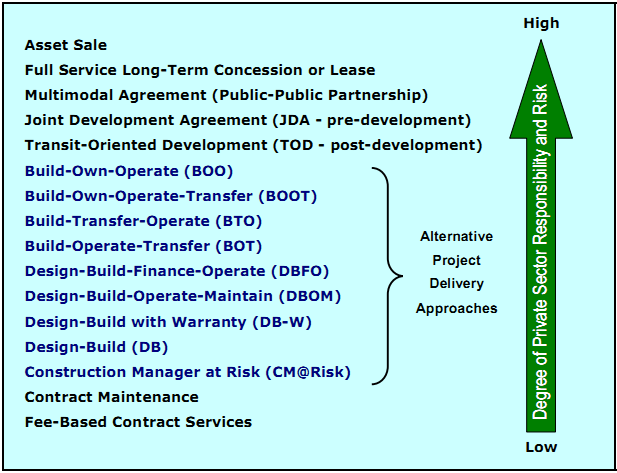
These five categories of transportation PPP arrangements, their components, and the benefits of each are described in more detail below. Exhibit 2.4 illustrates the hierarchy of major types of PPPs discussed in this chapter, starting at the bottom with PPPs that have the least private sector role and ending on the top with PPPs with the greatest private sector role.
Exhibit 2.4 Major Types of Transportation PPPs