HIGHWAY SYSTEM OVERVIEW
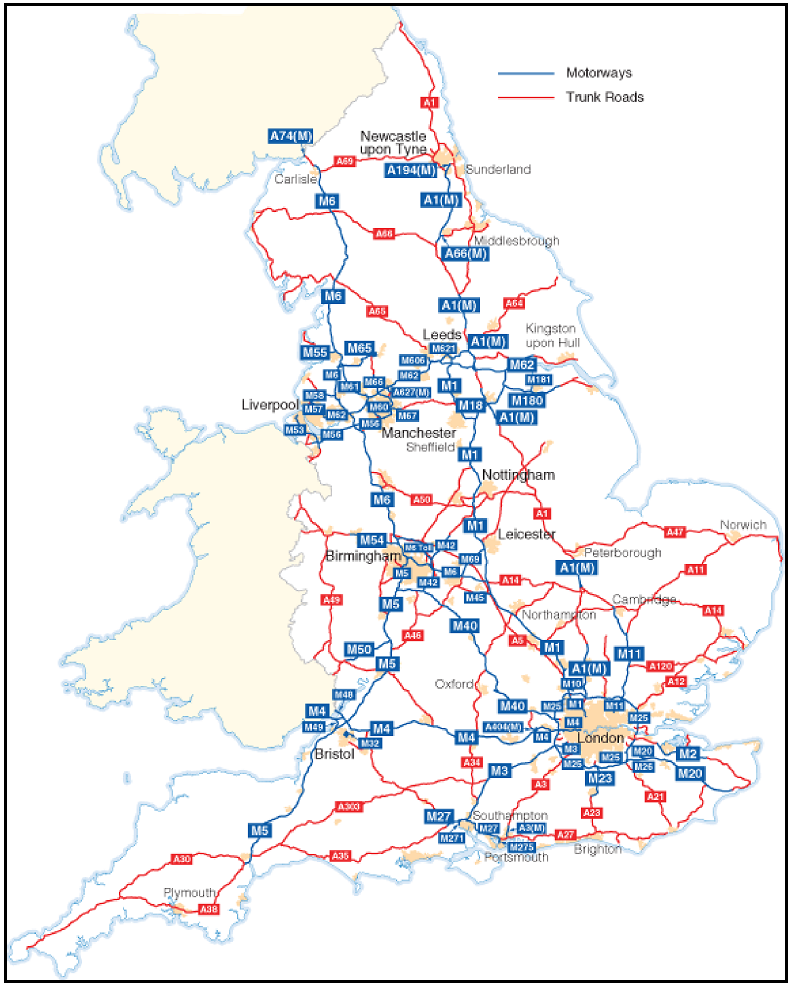
The Highways Agency, an Executive Agency of the Department for Transport (DfT), is responsible for operating, maintaining and improving the strategic road network in England on behalf of the Secretary of State for Transport. The Agency administers the strategic road network (shown on the next page as Exhibit 3.1) as a public asset, including overseeing through private Managing Agents contractors who design and build roadway extensions and expansions. The Highways Agency is also responsible for managing the traffic using these roads, leveraged through concessionaires who operate their franchised facilities. Other roads in England are managed by local authorities.
The Highways Agency manages England's strategic network by dividing the country into fourteen areas, each of which is assigned an Area team and a general engineering contractor, known as a Managing Agent (MA) or Managing Agent Contractor (MAC). Each Area team and corresponding Managing Agent is responsible for the maintenance of the Agency's roads in their area. Area teams are part of Traffic Operations Directorate. Managing Agents serve as general engineering consultants who support the Area teams in developing preliminary design plans and overseeing the technical work of project design and construction contractors.
Prior to the mid-1990s, the Highways Agency used traditional public funding sources and unit priced-based project delivery approaches to provide for the construction and maintenance of major motorways and trunk roads in England, with a Managing Agent engineering firm serving as general engineering consultant for project development. Construction and maintenance included advanced planning, design and building of new roads and structures (bridges, tunnels etc.), and the continual repair and replacement of the worn components of existing infrastructure, such as the road surface, lights, and road markings.
Exhibit 3.1 Strategic Network of Highways in England
|
Source: Highways Agency, July 2006. URL: http://www.highways.gov.uk/aboutus/139.aspx |
Following economic reforms instituted under the Government of Prime Minister Lady Margaret Thatcher, England embarked on a number of well publicized efforts to privatize major elements of the nation's transportation infrastructure assets. These included railroads, public transportation, and aviation. In addition, efforts were initiated to tap the financial resources of the private sector to help finance and deliver projects in a variety of sectors, including health care, accommodations, defense, and transportation. In 1990, the first design-build highway project contract was awarded in England.
England's plunge into public-private partnerships (PPPs) began in earnest in 1992 in the form of the Private Finance Initiative (PFI), which was intended to facilitate closer co-operation between the public and private sectors and introduce private sector skills and disciplines into the delivery and management of projects and services traditionally undertaken by the public sector. The Government's Highways Agency launched its PFI program in August 1994 with the announcement of eight motorway and trunk road projects to be delivered by private concessions, using design-build-finance-operations (DBFO) contracts financed by shadow tolls. The first of these DBFO project contract was awarded in England. In 2000 the first open book target cost contract was awarded, while in 2004 the first major Early Contractor Involvement (ECI) contract was awarded. In an ECI contract, the contractor becomes involved as early as the planning stage of the project, continuing through to construction completion and beyond if operations and maintenance are included in the contract scope. Compared to traditional delivery, the Highway Agency found that its total project delivery timeframe had dropped 45 percent from an average of 11 years to five years as a result of involving the private sector contractor earlier in the project development process.10
In the past twelve years, both public and private sectors in England have gained significant experience and confidence in using PPPs to fund and deliver infrastructure assets. According to Standard & Poor's, more than £48 billion in total capital has been invested in PPP projects in England to date with up to £64 billion in additional capital investment via PFI over the next sixteen years.11
____________________________________________________________________________________________
10 DeWitt, Steven D. 2004 International Construction Management Scan. Summary presentation of results from the 2004 International Scan of Construction Management Practices for Effective Project Delivery, Contract Compliance and Quality Assurance, sponsored by AASHTO, ARTBA, AGCA, and FHWA, through its International Technology Exchange Program, http://www.international.fhwa.dot.gov/construction_mgmt/index.htm.
11 Jamieson, Craig, Adele Archer, Robert Robinson, and Robert Bain. PPPs in the U.K. Maintain Momentum, Despite Some Bad Publicity. Standard and Poor's Commentary, April 25, 2005. Reprinted in Standard & Poor's Infrastructure & Public Finance Ratings - Public Private Partnerships, Global Credit Survey 2005, May 2005, pp. 16.