PROJECT DESCRIPTION
The QE2 Dartford Bridge was the first new crossing of the River Thames in 50 years when it was officially opened to traffic in 1991 by Queen Elizabeth. The $160 million (£86 million) project called for a double cable-stayed concrete bridge totalling one-half mile (812 meters) for the main span and two back spans, plus and a 0.6 mile (1 km) approach viaduct on each bank, which link the high level roadway over the river directly to the road network on the north side and the toll collection plaza and the road system on the south side. The total project provides a 1.73 mile (2.81 km) long four-lane bridge facility that rises 211 feet (65 meters) above the river at its highest point and has a center span of 1,463 feet (450 meters), making it one of the longest concrete cable-spayed bridges in the world and the longest in Europe.
The bridge carries southbound M25 traffic over the River Thames while the older two tunnels, each with two lanes and 0.55 miles (0.9 km) in length, carry northbound M25 traffic under the River Thames in the same vicinity near Dartford. The Dartford Crossing Bridge and two tunnels are all tolled facilities. The bridge has a capacity of 70,000 vehicles per day while the two tunnels have a combined capacity of 65,000 per day. Actual daily traffic volume is 85,000 vehicles, although this rises to 100,000 in peak periods. The Dartford Crossing facilities has 12 toll booths in each direction, charging $1.85 (£1.00) for cars, $3.34 (£1.80) for light vans, and $6.69 - $10.77 (£3.60 - £5.80) for trucks of increasing size. A seven percent discount is provided to users of the facilities' electronic toll collection system called DART-Tag.
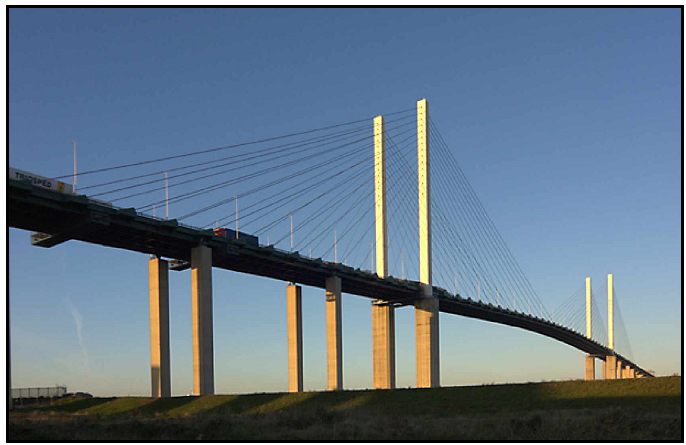
Exhibit 3.6 portrays the completed QE2 Dartford Bridge and approach viaducts carrying M25 over the River Thames.
Exhibit 3.6 QE2 Dartford Bridge
|
Source: Gillard-Reid, July 2006 |