ISSUES AND STRATEGIES
The risks to the PPP in financing and developing the QE2 Dartford Crossing Bridge were largely mitigated due to the following project-specific features:
• Competitive Position of Parallel Bridge. The project benefited from being located at a strategic choke point along a major urban highway surrounding London which was already highly congested and faced significant growth in traffic. As a bridge, tolling users of the facility was more accepted than if this were a toll highway. It took nine more years after the QE2 Dartford Bridge opened before the public accepted the first tolled highway in England, the M6 Tollway.
• Traffic and Revenue Risk to Concession Teams. The consortiums responsible for financing, developing, and operating the bridge were reasonably confident of the cash flow likely to be generated by tolls due to the long history of traffic and revenue data on the tunnels carrying the M25 orbital road under the River Thames and projections of future traffic volumes in this major trunk highway surrounding London.
• Capabilities of Development Team. The initial private consortium, Dartford River Crossing Ltd., was composed of a broad array of reputable firms with sufficient expertise and depth of resources to complete the project development within budget and schedule.
• Financial Risk to Government Sponsor. As a DBFO project, the bridge project posed little risk to the sponsoring government agency despite the many technical challenges and obstacles that had to be faced along the way such as coordinating the work around changing water levels and the river traffic of a busy tidal waterway.
• Use of Electronic Toll Collection. To handle the high volume of traffic using the Dartford Crossing facilities each day, the operating company installed an electronic toll collection system known as DART-Tag, a pre-paid account that provides users with a seven percent discount. The DART-Tag itself is a microwave transponder tag that is provided at no cost to the user. It classifies each vehicle when it enters the toll plaza and allows passage if there are sufficient funds in the subscriber's DART-Tag debit account.
Drivers are alerted to the status of their DART-Tag accounts by a colored lighting system at the toll plazas, where green means adequate fund reserves, amber means ten or less credits remaining, and red means no funds remaining. A red light means the driver must use cash to pay the crossing tolls until refurbishing the account. DART-Tag users represent 20 percent of the vehicles using the Dartford Crossing facilities. Automatic coin machines and manual cash collection are also available for those who do not use DART-Tag or have no funds in their accounts.
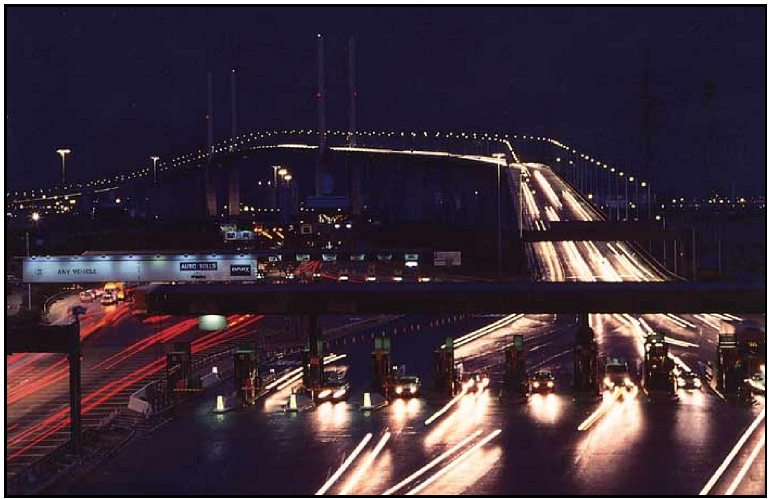
Exhibit 3.7 shows the toll plazas for the QE2 Dartford Bridge for southbound traffic and for the two tunnels carrying northbound traffic along the M25 orbital road.
Exhibit 3.7 Toll Service Plazas for QE2 Dartford Bridge (on right) and Tunnels (on left)
|
|
| Source: URL: http://www.highways.gov.uk/roads/projects/4069.aspx |