BACKGROUND
With the imminent reunification of Hong Kong with mainland China in 1997 and a policy shift to expand the nation's economic development, the regions of the country closest to Hong Kong were expected to significantly grow in the aftermath of reunification. This was expected to result in greater travel demands between the southern provinces of China and Hong Kong, China's gateway to the west and the most advanced capitalist part of China in the 1990s. To accommodate the projected growth in auto and truck travel between Hong Kong and mainland China, a number of highways, bridges, and tunnels were commissioned through PPPs in the 1990s and early part of this decade.
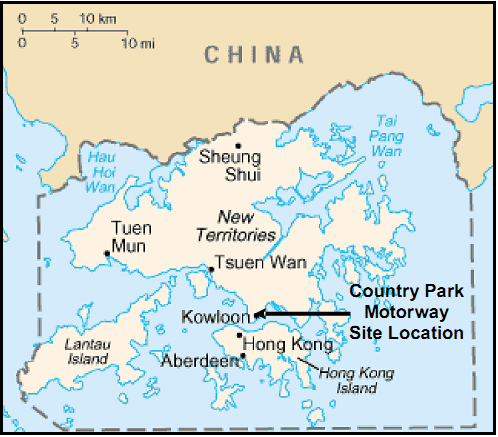
This case study discusses one of the connecting highways (Route 3 Country Park Motorway) which was developed through a Build-Operate-Transfer (BOT) PPP in the mid-1990s. The BOT PPP approach expedited project delivery to meet client schedule needs relative to the takeover of Hong Kong by China from British control in 1997. Another benefit was to expedite generation of funding from tolls to pay for the project cost over the 30 years franchise period. Due to the tight program schedule, a contractor consortium was set up for efficient construction management. Exhibit 4.6 provides an area-wide site map for the project.
Exhibit 4.6 Route 3 Country Park Motorway Site Map