BACKGROUND
Despite the political and terrorist challenges to the future of the State of Israel, the country is growing and the demand for additional highway infrastructure is increasing even faster. Underlying these needs are increased population dispersion from congested urban centers such as Tel Aviv, requirements for enhanced military mobilization, and public demands for greater mobility, safety, and air quality. Exhibit 4.10 provides an area-wide site map of the project and its proximity to the major urban centers of the nation and the parallel coastal roadway network. .
Exhibit 4.10 Trans-Israel Toll Highway 6 Site Map
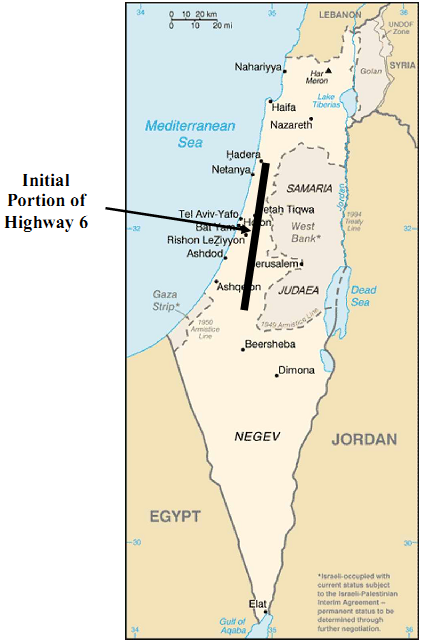
Source: URL: http://en.wikipedia.org/wiki/Image:Is-map.PNG
With limited financial resources to build a major highway that links the major urban centers of the country and provides additional north-south highway capacity to more fully integrate the nation, the State turned to a series of innovative approaches to build, finance, and operate the first phase of this strategic project. These included: revenue-based debt and equity financing, project delivery using a creative public-private partnership, and the latest in toll collection technology. These innovative approaches, several of which required legislative authorization, combined to produce a project in a timely manner, with risk sharing between public and private partners, and tolling features that minimize the time required to pay the tolls. This was especially important since this was the first toll road in Israel.