WESTERN MOTORWAY (M4 MOTORWAY)
Sydney, New South Wales, Australia
The M4 Western Motorway is the road traffic spine for the western suburbs of Sydney, extending a distance of 24.9 miles from Concord at its eastern end, through to Lapstone to the west of Penrith. Exhibit 4.16 shows the M4 Motorway in Prospect.
Exhibit 4.16 M4 Motorway in Prospect
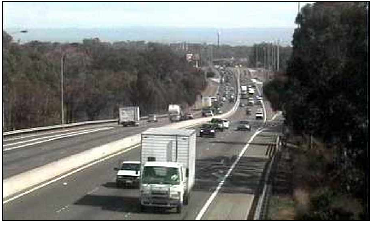
Source: Maunsell of Australia, 2005
The first section of the M4 Motorway was from Prospect to Penrith, completed by the NSW Government during the early 1970's. Several stages of the second section from Concord to Parramatta were completed in the 1980's. There remained a missing link of about 6.2 miles between Mays Hill (outside Parramatta) and Prospect to connect these two sections.
In 1989 the NSW Government invited proposals from private enterprise for the funding and construction of this missing link, and upgrading another 6.8 miles of the F4 Freeway. In open competition, Statewide Roads Limited won the right over a 20-year period to finance and build, and then operate and maintain the Motorway, after which the Motorway reverts to the Government at no cost. Macquarie Infrastructure Group owns 50.6% of Statewide Roads. Also awarded in this concession agreement was the right to develop and sub-lease two service centers at Prospect. These are currently being leased by SWR to McDonalds, Red Rooster, and Caltex. The concession ends in 2010.
The M4 Western Motorway opened in May 1992 and consisted of 6.2 miles of new dual carriageway expressway, 21 major bridge structures, and to upgrade and widen 6.8 miles of existing expressway at a cost of A$245 million. The completion of this section provided uninterrupted urban motorway conditions between Concord and Lapstone in Sydney's west.
In response to the success of the initial project, Statewide Roads undertook the upgrade and widening of the M4 Western Motorway from Parramatta to Penrith during the period 1996 to 1998. This involved the construction of an additional 43.5 lane miles to bring the road from four to six lanes, and in some areas eight lanes.
Issues/Results: There was considerable political pressure to remove the tolls prior to the 1996 NSW State Election. Upon election, the NSW Government subsequently implemented the "Cashback" scheme to refund tolls to all private-car toll trips in lieu of removing tolls. This innovation was the result of complex financial arrangements which allowed the toll road operators to derive considerable tax benefits. The implementation of shadow tolling would have seen these tax benefits lost. The State Government recently called for expressions of interest for the construction (through a PPP) for the final extension of the M4 to connect to the Sydney CBD.