Does Political Will Exist?
One of the greatest barriers to more widespread use of PPPs is the absence of an appropriate legislative framework to provide specific authority as well as limitations on the use of PPPs. From the Contractor/Developer perspective the absence of required legislation is not necessarily a fatal flaw but rather an additional hurdle that must be considered from a cost, timing and likelihood of success perspective. To the extent that the Contractor/Developer seeks to create or modify the legislative framework, well planned and resourced political action will be required.
The support or resistance likely from what will ultimately be the implementing agency needs to be carefully assessed to avoid a situation that is like "trying to push a string." Similarly, the actual legislation and any implementing regulations need to be carefully reviewed and assessed. Is the climate right?
The procurement process that is anticipated must be assessed even if it is still evolving. Will it be transparent with objective criteria and will it be staffed by quality people with the skills required to evaluate a non-traditional financing and delivery option? The willingness of the agency to embrace change is essential to capture the full benefit of PPPs and private sector innovation.
But good legislation and good regulation is not enough. Political will must exist. PPPs, at least in these earliest days, are fraught with risks for the public sector. These risks require political leadership willing to confront these challenges head on and move through them expeditiously.
Delay is one of the greatest risks the Contractor/Developer faces. To avoid projects with extensive delays, determine if political will exists early in the process and reaffirm its continued existence throughout the entire development period. Figure 1 demonstrates this process.
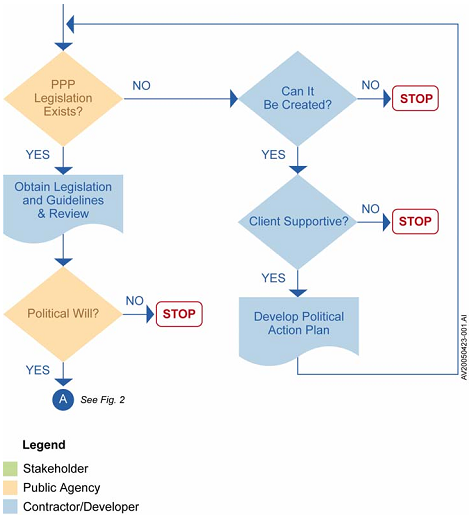
Figure 1. Does Political Will Exist?