Appendix 4: Evaluating the Carbon Impact of Residual Waste Treatment Options
Evaluating the Carbon Impact of Residual Waste Treatment Options
Options appraisal within the OBC must take account of greenhouse gas emissions (GGE)21 impact of the residual waste treatment process. These emissions are normally expressed as a tonnage of carbon dioxide equivalents (CO2e).
The impact of the CO2e emissions should be converted into a monetary value by applying the Shadow Price of Carbon (SPC). This is currently equivalent to £26.5/t CO2e (2008 price), increasing by 2% per year in real terms to account for rising damage costs from higher concentrations of greenhouse gas emissions. Guidance on how to apply the SPC in appraisals is available at:
www.defra.gov.uk/environment/climatechange/research/carboncost/step1.htm
Background information and further explanation of the SPC is available at:
www.defra.gov.uk/environment/climatechange/research/carboncost/index.htm
The basic steps in valuing the carbon impact in OBC are as follows:
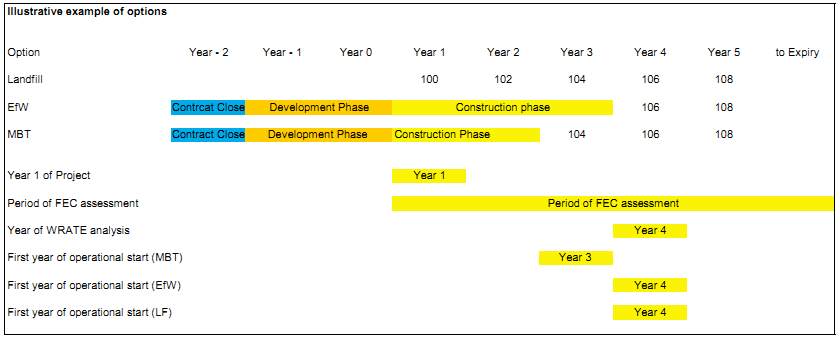
1. For each option under appraisal determine the total annual CO2e emission (use WRATE). The year selected for the analysis should be the 1st year in which the full waste management system is operational.22
2. Determine the CO2e per tonne of residual waste processed - division of the total figure determined in (1) by the total tonnage of residual waste processed in that year.
3. Determine the CO2e emissions in future years by multiplying the 1st year emission per tonne with the tonnage treated in each subsequent year. In this way emissions are estimated for each operational year. This method provides an approximation of the emission per year without the (time consuming) necessity of running WRATE for each of the 25 to 30 years of operational life.
4. For each option determine the annual cost of carbon emissions by multiplying the annual CO2e emission by the applicable SPC (£/t).
5. For each option determine the net present value (NPV) of the carbon emissions. The discount rate to apply for the NPV calculation should be the same as that applied in the other cashflows, i.e. based on HMT Green Book Guidance.23
Defra expects all Authorities applying for PFI funding to calculate the cost of carbon emissions for each residual waste treatment option considered in the options appraisal. Authorities are required to use the WRATE model to determine the CO2e emissions as noted above. To perform steps 2 to 6 WIDP have developed a spreadsheet model to do the necessary calculations.24 The model also takes account of the profile of methane emissions from landfill and values air quality impacts. Additionally, the model provides further guidance on the treatment of the relevant WRATE outputs and the calculation of the SPC. The model can be accessed from the WIDP website:
http://www.defra.gov.uk/environment/waste/localauth/funding/pfi/guidance.htm
or by clicking on the icon below:
|
|
| Microsoft Office |

Once the SPC has been determined it will be possible to compare the relative performance of options against the FEC as well as the FEC (excluding landfill tax and LATS) including SPC.
The figure below illustrates the period over which the FEC and WRATE analysis should be undertaken for a typical case.
_________________________________________________________________
21 In WRATE the equivalent term used is Global Warming Potential (GWP).
22 The WRATE analysis can exclude upstream recycling activity if this is common to all options e.g. if all options are achieving 50% recycling the analysis of CO2e emissions can default to a consideration of impacts from residual waste only.
23 http://greenbook.treasury.gov.uk
24 The spreadsheet model fixes the base date for discounting purposes and it is important that this is used consistently for all discounting exercises undertaken to calculate the FEC.