The Method: PPP Project Delivery Models
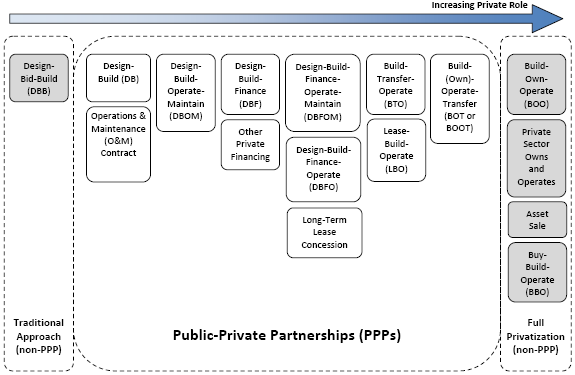
The second key characteristic of a PPP is the method used for project delivery. PPP project delivery models can be thought of as being on a continuum of public-private mixes (Figure 2).15 At one extreme is traditional public project delivery, where the public sector finances, owns and retains control over the project throughout its life cycle. Such projects may outsource certain functions to the private sector-through traditional design-bid-build contracting, for example (see Glossary)-but they are not PPPs. At the other extreme is privatization, where projects are privately financed, owned and controlled, subject only to overarching public laws and regulations. These, too, are not PPPs. Between these poles of public and private control lie a range of PPP options, where the public sector retains ultimate responsibility for and ownership of an asset, but the private sector assumes one or more traditionally public roles in and responsibilities for project delivery.
Roles assumed by the private sector in a PPP can include designing, building, operating, maintaining or financing a facility and, in some cases, assuming limited-term ownership. Thus, as shown in Figure 2, PPPs range from design-build contracts,16 in which one private contractor is responsible for both the design and construction of a project, to build-own-transfer, in which a private entity owns an asset for a period of time before eventually transferring ownership to the public sponsor. (See Glossary for more about specific PPP project delivery models and innovative contracting approaches.)
| Figure 2. Project Delivery Models Along a Continuum of Private Sector Involvement17 |
|
|
Another way to think about PPP project delivery models is in terms of risk allocation. In traditional project delivery, all risk for a transportation project is borne by the public sector. PPPs, in contrast, are characterized by a transfer of risk associated with a transfer of responsibilities, and essentially differ based on which risks and responsibilities for a facility are contractually transferred to the private sector (Table 1).18 When the private sector assumes a risk in a PPP, it becomes responsible for solving certain potential problems that might arise in project delivery and for absorbing related financial losses (or, conversely, for benefiting from related financial gains). Risks usually assumed by the private sector include those associated with the phases of the project with which it will be involved, such as those related to uncertainties in construction cost, schedule, operations and maintenance and, in some cases, traffic and revenue. The public sector tends to retain risks related to uncertainties in environmental permitting and clearance, right-of-way acquisition and changes in applicable law. Environmental and force majeure risks may be shared.19
| Table 1. Private Sector Risks and Responsibilities under Different Project Delivery Models20 | |||||||||||||
| Functional Responsibilities and Project Risksa | |||||||||||||
| Project Delivery Models | Planning | Environmental Clearance | Land Acquisition | Finance | Preliminary Design | Final Design | Construction | Construction Inspection | Maintenance | Operations | Long-Term Preservationb | Traffic Revenue | Asset Ownership |
| • | • | ||||||||||||
| Design-Build (DB) | • | • | • | ||||||||||
| Design-Build with Warranty | • | • | • | • | |||||||||
| Operate and Maintain (O&M) | • | • | |||||||||||
| Construction Management at Risk (CM at Risk) | • | • | • | • | |||||||||
| Design-Build-Operate-Maintain (DBOM) | • | • | • | • | • | • | • | ||||||
| Design-Build-Finance-Operate (DBFO) | • | • | • | • | • | • | • | ||||||
| Brownfield Concession | • | • | • | • | • | ||||||||
| Greenfield Concession | • | • | • | • | • | • | • | • | |||||
| Build-Transfer-Operate (BTO) | • | • | • | • | • | • | • | • | • | ||||
| Build-Own-Operate-Transfer (BOOT) | • | • | • | • | • | • | • | • | • | • | • | • | • |
| • | • | • | • | • | • | • | • | • | • | • | • | • | |
| Asset Sale (not a PPP) | • | • | • | • | • | • | |||||||
| Notes a Functional responsibilities and project risks noted with a dot may be transferred entirely to the private partner or shared with the public sponsor, depending on the contract. b Refers to long-term risk of asset failure or physical obsolescence. | |||||||||||||