Principle 5: Take a long-term perspective
State legislators will want to approach PPP decisions with the long-term impacts in mind.
PPPs can have long-term consequences and, according to the Pew Center on the States, "a long-term deal deserves a long-term perspective."162 Legislators should approach decisions about PPPs with the long-term public interest in mind-not just short-term needs. State legislators and executive agencies can incorporate a long-term perspective at every stage of the PPP decision-making process-whether deciding if the state is to pursue PPPs, crafting enabling legislation, creating a PPP program, evaluating and selecting projects, engaging in procurement, or planning for ongoing contract management and oversight.
Executive agencies will generally be responsible for assessing the long-term effects of particular projects; in states where legislators approve specific projects, this is also a legislative concern. When considering particular projects, a 2006 Deloitte study advocates adopting a holistic view of a PPP project's entire life cycle from the outset. This perspective "provides a framework for evaluating whether the solution is the most appropriate for the public over time," allows the public sector to plan in advance, helps governments understand how decisions throughout the process will affect the project's long-term success, and "best insures the interest of the government agency that retains ownership and ultimate responsibility for the asset throughout the life cycle."163 During this stage, it is worth considering potential long-term positive and negative effects on the overall transportation system, the environment and the public interest, as well as value for money for the public sector (see also Principles 3, 6 and 7).
Certain elements of the contractual agreement also may need particular attention from a long-term perspective. Legislators may address contract issues in statutory guidelines, while executive agencies will generally be responsible for individual agreements. Depending on the type of PPP being considered, relevant provisions may include limited compete or noncompete clauses, labor protections, risk allocation, term lengths, operations and maintenance standards, environmental performance standards, termination clauses, and provisions that specify the minimum condition of the asset when it is returned to the public (known as "hand-back" provisions).164 Contract flexibility also is a key issue that deserves special attention from a long-term perspective.
The potential long-term positive and negative economic effects of PPPs will need to be considered throughout the process. Possible benefits include job creation, transfer of risk away from the public sector, the value of having certain infrastructure projects delivered more quickly and the potential cost savings of PPPs-up to 40 percent, according to the U.S. Department of Transportation165-due to innovative contracting and integrated project delivery.
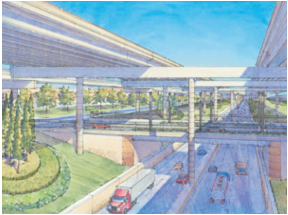
I-635 (LBJ Freeway) Managed Lanes Project, Texas (DBFOM). Expected to open in 2016, this project will add six managed lanes along I-635 (subsurface) and I-35E (elevated), besides reconstructing the main lanes and frontage roads. The private partner is under contract to operate and maintain the facility for 52 years. (Photo: Texas DOT) | Analyses of PPPs' long-term economic risks have tended to focus on brownfield concessions. Some well-publicized deals have been especially criticized for prioritizing the short-term benefits of up-front payments over the state's long-term economic interests. A U.S. Public Interest Research Group analysis comments that the 75-year lease of the Indiana Toll Road-authorized by project-specific legislation-was intended to finance the state transportation plans for only the first 10 years. After that, the state may have the same structural budget problems, but not the toll revenues.166 Pennsylvania's attempted turnpike lease received similar criticism.167 The New York Citizens Budget Commission also has warned against trading more valuable future revenue for immediate proceeds, essentially shortchanging future generations.168 These concerns must be carefully addressed and balanced against other potential long-term benefits and risks of a project. |