3.2 Various Models of Public-Private Partnerships and Private Participation
Texas has a long history of private sector involvement in building and maintaining our state's highways. The public's relationship with the private sector need not be "all or nothing." Rather, it is more accurate to think of private participation as a continuum of ways to include the private sector ingenuity and capital, all while maintaining full public control and oversight.
It is unfortunate that the term "private participation" has become, in the eyes of certain segments of the public, inextricably linked and synonymous only with the Trans-Texas Corridor (TTC) project. The reality is that a spectrum of partnership structures exist for private participation that need to be considered and better understood.
ALTERNATIVE CONTRACTUAL ARRANGEMENTS FOR DELIVERING HIGHWAY INFRASTRUCTURE58
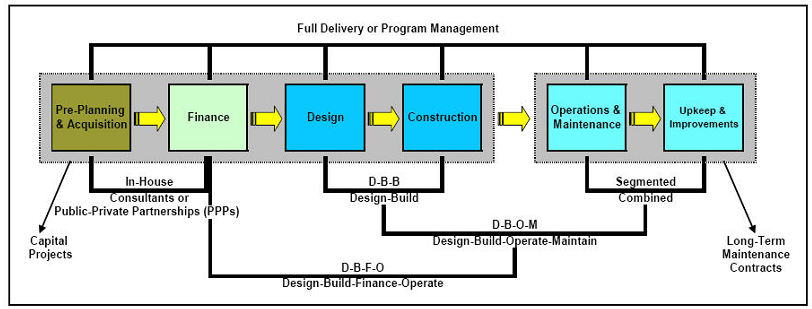
Texas has utilized the services of private contractors in the traditional Design-Bid-Build ("DBB") procurement framework since the early 1920s. Until the late 1990s, this was the only legal contracting method for all types of state construction - the argument being that separating design and construction responsibilities reduced fraud and minimized the incentive to employ unsafe design or construction practices in an effort to save money.59 For many years, state law mandated a Qualifications Based Selection ("QBS") process for the design element,60 while requiring the construction contract to be awarded by competitive bid.
A movement in the late 1990s pushed to change the law to allow Design-Build ("DB") contracts for "vertical" construction (i.e., state and local government buildings and schools), but the resulting legislation specifically excluded "horizontal" construction such as highways and water projectunder the reasoning that vertical structures are governed by building codes and that key safety issues are not entirely dependent on the designer's engineering judgments,61 under the reasoning that vertical structures are governed by building codes and that key safety issues are not entirely dependent on the designer's engineering judgment.62
Texas law changed in 2003 to permit Design-Build contracts for highways, but only under the aegis of a Comprehensive Development Agreement.63 A bill in 2003 to establish a design-build pilot program for 24 TxDOT projects above a $50 million cost threshold passed the Senate but died in the House.64 Thus, as of now, DB contracts may only be used in Texas in the context of CDA projects.
The federal government has taken a more active role in encouraging alternative contracting arrangements. In 1990, the Federal Highway Administration (FHWA) established Special Experimental Project 14 (SEP-14) to enable state agencies to evaluate a variety of alternative project contracting methods. By the end of 2002, 140 projects representing $5.5 billion, had been completed under SEP-14.65 The 1998 highway reauthorization bill, the Transportation Equity Act for the 21st Century (TEA-21), required the FHWA to conduct a comprehensive national study to evaluate the effectiveness of design-build contracting.
This FHWA Study found that the DB approach reduced the average duration of highway projects by 14 percent and the average cost by 3 percent with no loss in quality - though the study did find a wide disparity between the results of individual projects.66 The DB approach was found most suitable for large, complex projects and least suitable for small projects, such as road resurfacing. Key advantages of DB contracts were:
This FHWA Study found that the DB approach reduced the average duration of highway projects by 14 percent and the average cost by 3 percent with no loss in quality - though the study did find a wide disparity between the results of individual projects.66 The DB approach was found most suitable for large, complex projects and least suitable for small projects, such as road resurfacing. Key advantages of DB contracts were:
• The elimination of delays resulting from a second procurement cycle for the "build" phase
• A significantly lower number of claims, reflecting a fundamental shift in the adversarial nature of transportation contracting
• Fewer change orders (though the average cost per change order tended to be higher than with DBB)
• More innovative solutions in complex projects
The FHWA study noted, however, that DB contracts were "not a panacea," and stressed the importance of trained and capable contracting agency staff to administer DB projects. Moreover, "the presence of a number of competent design and construction firms interested and willing to compete for work … helps to ensure cost-competitive bids."67
The Study also cautioned that "while many of the conditions that spawned the promulgation of highly restrictive contracting laws and procedures early in the twentieth century are no longer in evidence, care must be taken to prevent a repeat of these conditions []. Contracts must be … entered into with the understanding that the public and private participants … have a shared interest and liability for the process results …"68
To date, Texas has two "Design-Build" projects: SH130, Segments 1-4 to the north and east of Austin and the US183 project in northwest Austin.69
Texas also has one Design-Build-Finance-Operate project under development (DBFO or DBFOM is what many think when they hear the term "CDA"). This is SH130, Segments 5&6, which will link SH130, Segments 1-4 to I-10 near Seguin.
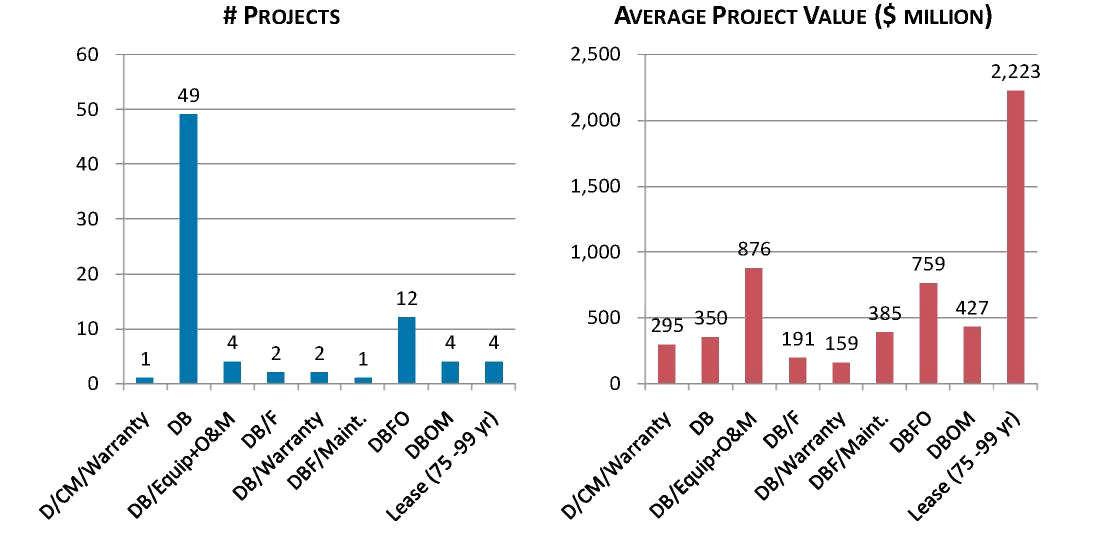
Another study looked at 79 transportation projects in the United States and Canada from 1989 to 2008. Of these, 62 percent were "Design-Build."70 Only 15 percent followed the DBFO model.
US and Canadian Transportation Projects with Private Participation (1989-2008)71
Most Design-Build and DBFO projects involve tolling, but the traditional form of tolling is not required, even for CDA-type concessions. Two alternative methods do not directly toll motorists: availability payments and shadow tolling.
With availability payments, the governmental entity pays the private builder a set fee based on lane availability rather than traffic volume. This method is particularly useful to build roads where future costs are expected to be considerably higher than those of today - notably the outskirts of fast growing metropolitan areas where today's traffic is too low to support the road's full cost, but where development could soon make right of way acquisition prohibitively expensive.72
Availability payments are a common technique in the U.K., though the arrangement is new in the U.S. The I-595 upgrade west of Fort Lauderdale, Florida will be the first such American project. The state will charge express lane users a variable toll, but will compensate the DBFO Company via availability payments rather than direct toll revenue.
Shadow tolling takes a similar approach. In this case, the public or private entity developing the project will finance, construct, maintain and/or operate a project. The state then reimburses a portion of the project cost by making periodic payments to the developer for each vehicle that drives on the highway. A new highway project can be tolled or non-tolled.73 Texas' Pass-Through Financing plan is an example of shadow tolling, as are similar devices in the U.K. and Portugal.74
The disadvantage of availability payments and shadow tolling is that they bring no new money into the system.
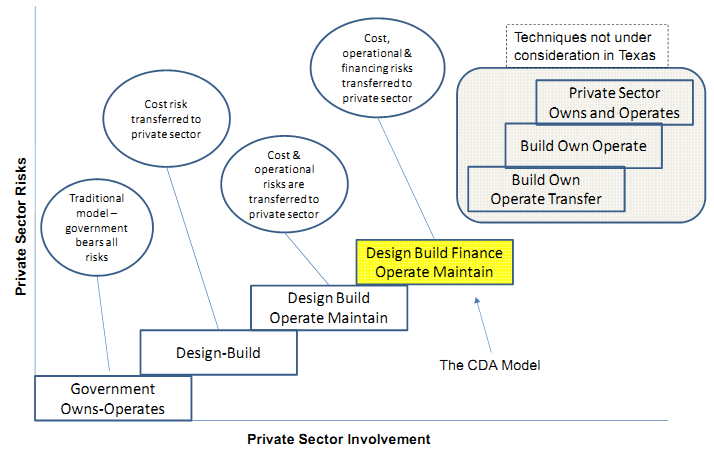
To summarize:
SPECTRUM OF PRIVATE SECTOR INVOLVEMENT AND RISK
________________________________________________________________________________
58 FHWA Design-Build Effectiveness Study, January 2006, p. i, citing Pakkala, Pekka. Innovative Project Delivery Methods for Infrastructure-An International Perspective. Finnish Road Enterprise, Helsinki, 2002, p. 32.
59 This was also driven by corruption scandals involving Highway Department officials and contractors in the 1920s.
60 The QBS process required that professional services - design - be selected not by low bid, but by demonstrated competence and qualifications at a fair and reasonable price.
61 SB 583 (1999), SB 510 (2001).
62 Design-Build and Alternative Project Delivery in Texas, Texas Council of Engineering Companies, April 2004.
63 In 2003, House Bill 3028 also permitted the Design-Build approach for ports.
64 SB 1499.
65 FHWA Design-Build Effectiveness Study, January 2006, p. ii
66 FHWA Design-Build Effectiveness Study, January 2006, p. v
67 FHWA Design-Build Effectiveness Study, January 2006, p. xiii
68 Ibid.
69 US281 in San Antonio is included in PWF's list, but this project has been shelved indefinitely.
70 Source: Public Works Financing, September 2008, pp.22-23.
71 D = Design; CM = Construction Management; F= Finance; B = Build; O&M = Operations & Maintenance
72 One variation of the availability payment approach would be to build the road as a toll road and set up a sliding scale where availability payments are reduced as traffic volumes and toll revenues increase. After a certain level, the road could be converted to a standard toll facility.
73 Source: TxDOT Pass Through Financing brochure.
74 Note that Portugal recently changed policy to shift away from any "free" roads not requiring some form of payment by the roads' users.