3.3. Very few Projects are Toll Viable
Toll roads began in postwar Texas with the establishment of the Texas Turnpike Authority in 1953 and the opening of the Dallas-Fort Worth Turnpike in 1957.75 In 1966, construction began on the Dallas North Tollway, and in 1983, a referendum of Houston area voters approved the creation of the Harris County Toll Road Authority (HCTRA).
The North Texas Tollway Authority (NTTA) (successor to the Texas Turnpike Authority) and HCTRA operate the two major toll road systems in Texas. Other notable toll roads include the Central Texas Turnpike system (SH45, SH130, parts of Loop 1 in Austin), Loop 49 (Tyler), and SH255 (Laredo).
A popular misconception of toll roads in general is that toll roads will soon "take over the state." This is simply not true. Witnesses before the Committee and our own research have found that tolling is a viable option for only a very limited subset of the state's roads.76 Even federal officials have described tolling as the "seven percent solution."77
In 2007, TxDOT identified 87 'Candidate Toll Projects'. The agency first conducted an initial screening of all TxDOT Unified Transportation Program (UTP) projects for toll viability. Then, TxDOT narrowed this list to large, added-capacity projects with heavier traffic volumes; and solicited TxDOT District input on which of each District's larger added-capacity projects could benefit from a potential CDA delivery process. Finally, the agency combined or phased the projects into initial segments of logical termini.78
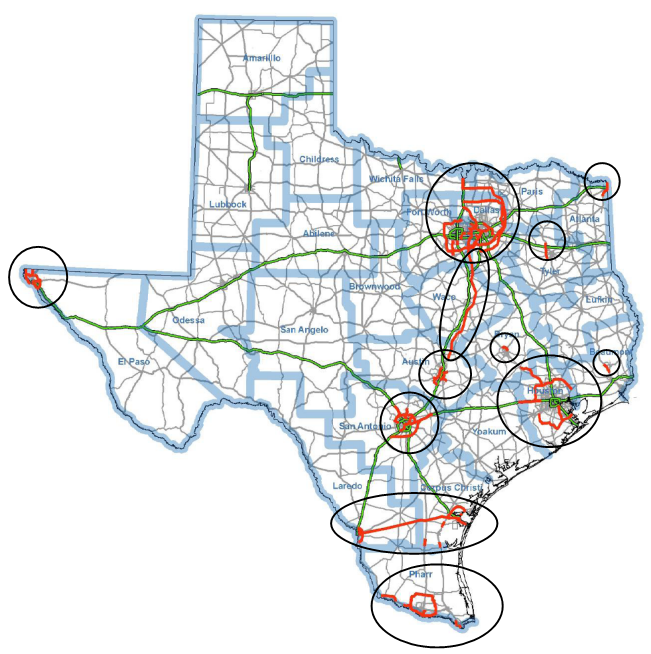
With few exceptions, these 'Candidate Toll Projects' are concentrated in the state's major metropolitan areas. Less populated regions simply do not have the requisite traffic volumes to support and economically justify tolling as a realistic option to pay for highway construction, nor are such projects able to generate sufficient revenues to support the projects. In addition, the Committee notes the following:
• The threshold floor for inclusion in the list was the ability of the project to generate sufficient revenue to pay for the cost of toll collection - not for the construction or operation of the road itself.
• Sources within TxDOT speaking not for attribution indicated that of the 87 projects, only about 30 were truly viable toll roads, and of this group, "only a handful" had the potential to earn back their full costs via toll revenues.
• Many toll projects require a combination of funding sources. When considering financing options for funding toll projects it is important to consider that: few projects are 100% toll viable.
It also bears mentioning that even if every road to be built were toll worthy, Texas would not necessarily follow this course, given the public's unwillingness to support such a system past a certain point. In addition, since most of the potentially revenue viable toll projects are located in the urban areas, there will come a point where local planners will need to balance the building of more roads versus investing in alternatives such as rail, especially if the criticality arises from air quality concerns versus congestion relief and/or general economic expansion.
POTENTIAL TOLL VIABLE PROJECTS (CIRCLES HIGHLIGHT PROJECT LOCATIONS)79
The primary advantage to tolling is that it brings new revenue streams beyond the gas tax into the system, and that these revenue streams allow projects to be built long before the state could have afforded to construct them using the pay-as-you-go approach. Equally significant, tolling helps achieve a fundamental goal of project finance, which is to match the funding mechanism of the investment to the life cycle of the infrastructure asset.80
______________________________________________________________________________________________________________________________
75 In 1977, the Turnpike's debt was retired 17 years early, and the toll booths were removed.
76 Source: TxDOT: Open for Business, Toll Feasibility Analysis, Summer 2007. TxDOT's own terminology is somewhat confusing on this issue. TxDOT has separate definitions for "Toll Feasible" and "Toll Viable." According to TxDOT:
• Toll Feasible - "a candidate toll project that is able to generate enough revenue to pay for the cost of collecting tolls."
• Toll Viable - "net toll revenue after operations and maintenance costs is sufficient to sell bonds, and the portion of the project cost funded through bonds is sufficient to cover the portion of project development and construction costs not covered by public or other sources of funds."
Further confusing the issue, TxDOT defines "Toll Feasibility Analysis" as "a screening analysis process used to determine whether a project, group of projects or corridor can generate net revenues after O&M costs have been covered and what portion of project cost can be covered by bonding the net revenues from tolls."
77 Testimony of Jennifer Mayer, USDOT - San Antonio hearing 22 July 2008.
78 The final list rose to over 100 when all phases or projects that were added late in the process are counted. Source: Texas Transportation Commission, Minute Order, 26 June 2007.
79 The original map highlighted the potential toll viable projects in red. The circles identify project locations that are not necessarily clear in black and white. It is important to note that existing Interstate lanes will NOT be tolled.
80 We will address an additional benefit of Public Private Partnerships - the ability of private capital to leverage that capital in a way that public entities cannot - in a later section of this report.