Risks Associated with Greater Government Involvement
As the government considers participation options, there is a need for a thorough analysis of all the risks that are being taken by the government and determination of whether the risk sharing is appropriate for proper execution of the project. The primary risks of government participation include the following:
• Increased Financial Exposure: As illustrated in Figure 5 (Babbar and Fishbein 1996) and discussed in Section III, the participation of the government in a project's financing carries varying degrees of contingent liability. As the government assumes more risk or invests more money into the project, it becomes exposed to a greater share of the damages should the project fail. Therefore, the level of involvement should be strategically and uniquely suited to the needs of the project.
• Degree of Government Involvement: A second risk associated with greater government participation may be a temptation on the part of the government to become too involved in the performance of the project, potentially to the point of interfering with the private party's ability to perform the service. As the government's risk profile increases, there is a need to develop a healthy balance between timely reviews of project progress versus interference in the planning and implementation of the project.
• Loan Security Issues: A third risk of greater government involvement is the complexities that may arise in the relationships with the potential investor or lender to a project versus otiier lenders or investors. In certain scenarios, the government could be a subordinated lender to a project leaving a majority of the assets of the project pledged to outside senior lenders.
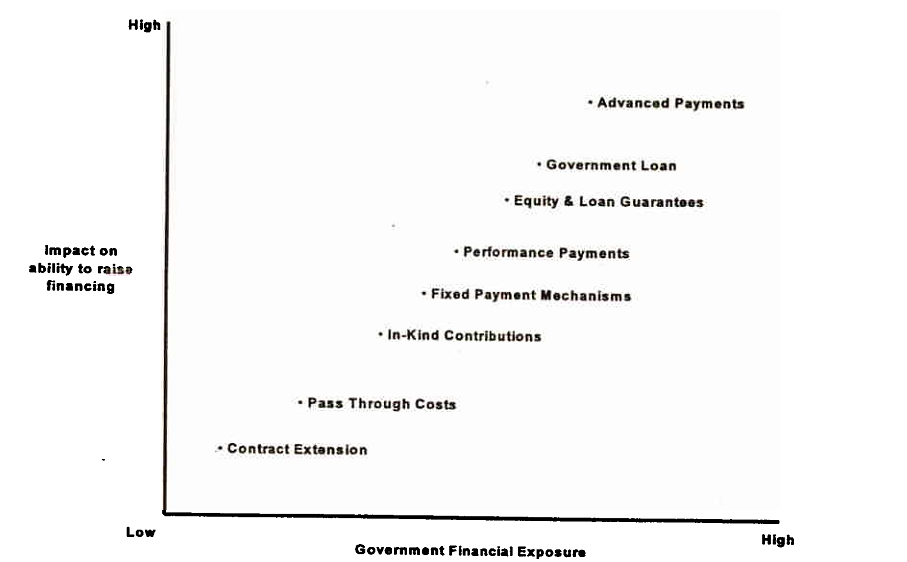
Figure 5. Government Financial Exposure
In addition, certain roles potentially available to the government could place the government at risk as a part of the private consortium with potential exposure to third-party liability or claims.