United Kingdom
The United Kingdom has transportation plans with a regional focus as well as a Programme of Major Schemes.7
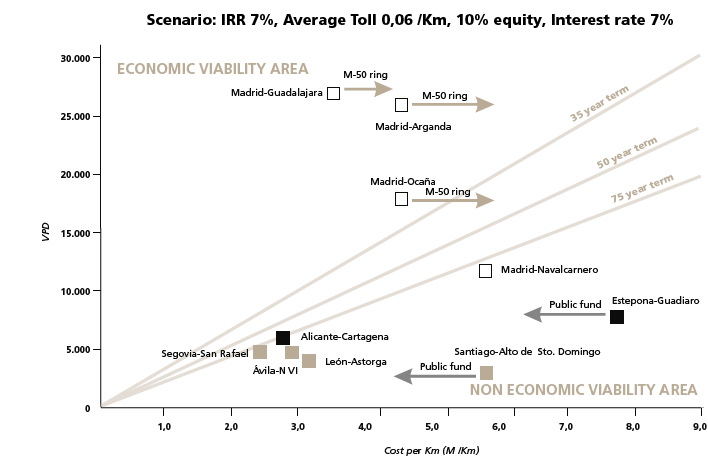
Figure 9. Example of Spain’s preliminary economic viability analysis of projects.
Figure 10 shows the past and future focus of the Highways Agency's investments. The decision on the delivery approach for schemes will consider (1) individ- ual scheme priorities, (2) current or pending program commitments, (3) capital costs, and (4) network occupancy against a hierarchy of delivery options. A private finance strategy must be considered first for any major scheme (defined as any scheme with a capital cost exceeding £7.5 million), but schemes valued at less than £100 million are likely to offer better value if delivered conventionally.
When a major scheme is identified, the project delivery strategy is determined jointly by Major Projects and the Procurement Division. In the case of a potential PPP, a VfM analysis is started by examining five areas:
♦ Does the project have sufficient scale to offset the transaction costs of procurement and implementation?
♦ Can the public sector define its needs and services?
♦ Does the private sector have the appropriate experience and can it deliver?
♦ Can whole-life (life-cycle) services be quantified?
♦ Are there appropriate performance measures for assessment of the private sector?
If this examination suggests that VfM is possible, then a PSC analysis is conducted. The intent of the PSC analysis is to determine if a PPP approach generates value against a public provision strategy when life-cycle costs and risks are quantified, as depicted conceptually in figure 11. In the case illustrated, the PPP approach demonstrates value for money because the base case plus risks retained by the public sector are less in the PPP approach than the public provision estimate (the PSC) of the base case plus the risks retained.8 After completion of this analysis, either a PPP delivery is chosen or not.
Of note is the difficulty and controversy that surround the use of VfM and PSC analyses. The challenges of implementing this methodology are captured by comments from U.K. elected officials:(f)
Successive administrations have adopted the policy of using the PFI for those cases where the approach is expected to deliver value for money. The Prime Minister said in September 2002 that the PFI has a central role to play in modernising the infrastructure of the NHS (National Health Service)-but as an addition, not an alternative, to the public sector capital programme. Yet the PFI is too often seen as the only option. To justify the PFI option, departments have relied too heavily on public sector comparators. These have often been used incorrectly as a pass or fail test; have been given a spurious precision which is not justified by the uncertainties involved in their calculation; or have been manipulated to get the desired result.
Despite such criticism, the methodology at the very least promotes the use of a systematic and auditable process, rather than an expedient or politically motivated one, for making a project delivery decision. In addition, it encourages a thorough business case analysis for any project, particularly large-scale endeavors.
____________________________________________________________________________________
7 The Highways Agency in the United Kingdom uses the term "scheme" to refer generally to requirements or potential projects.
8 HM Treasury no longer requires the development of a PSC for PFI projects generally; the treasury has determined through its audits and experience that a project with the appropriate attributes most likely will pass the PSC test. The Highways Agency still makes use of the PSC as a mechanism to lend credibility to its delivery decision.