Australia
All three states generally follow a multistage competitive procurement process. As discussed previously, both Victoria and Queensland have opted to form temporary public agencies for the sole purpose of procuring and commissioning highway PPP projects. Figure 14 illustrates the structure of the Southern and Eastern Integrated Transport Authority (SEITA), which was established to procure Victoria's EastLink. "Case Example: EastLink" (see page 35) explains certain features of the unique project.
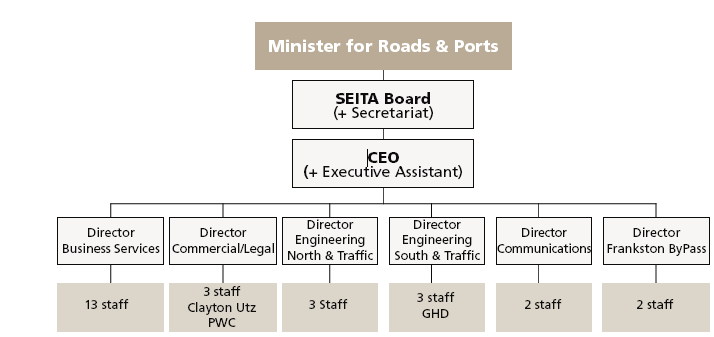
Figure 14. Structure of Victoria’s SEITA.
| Case Example: M25 | |
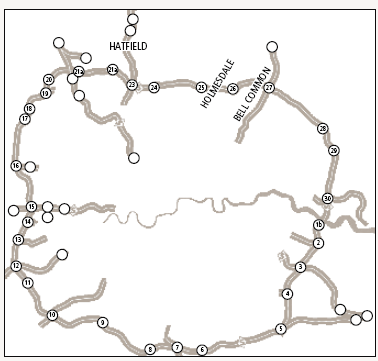
| Background and Chronology The M25, the orbital motorway that encircles London, is one of the busiest stretches of roadway in the U.K. system. Although considered a single entity today, the M25 was constructed in a piecemeal fashion from 1975 to 1986. Since then, certain sections have been lengthened and widened. Congestion on the orbital and its contiguous roadways led to the ORBIT Multi-Modal Study to examine measures to improve overall mobility in the area. The study concluded that additional capacity was needed on the M25, as well as implementation of Integral Demand Management techniques: (1) incident management, (2) lane management, (3) access management, (4) traveler information, and (5) wide-area traffic management. Following a business case analysis, the Highways Agency decided to pursue the needed improvements via a PPP arrangement-a DBFO delivery using a direct payment mechanism for a contract period of 30 years starting in 2009. The project road, roughly 400 km (249 mi) long, consists of the M25, the A282 Dartford Crossings, and intersecting radial trunk roads, as shown in figure 15. The project scope requires the PPP contractor to widen four sections of the M25 (roughly 100 km or 62 mi) from a dual three-lane to a dual four-lane route. The expected capital cost of the widening is £2 billion, and construction is anticipated to take 8 years. In addition, the PPP contractor will assume responsibility for operating, maintaining, and managing the road.
Figure 15. The M25 orbital roadway
Milestones in the project's implementation to date are as follows: ♦ November 2005-OJEU notice ♦ November 2005 to March 2006-Prequalification ♦ April to October 2006-Invitation to submit outline proposals (ISOP) ♦ March to October 2007-Tender stage ♦ November 2007 to April 2008-Evaluation and negotiations10 ♦ June 2008 to January 2009-Post tender and financial close Interesting Aspects of Procurement and Delivery For the M25, the Highways Agency's general procurement process was augmented somewhat because of the project's complexity and to minimize the transaction costs for both the public and private sectors. Before the formal tender stage, the Highways Agency issued an ISOP, which required the five prequalified teams to respond to a questionnaire on quality issues such as processes, resources, and organizational values. Following assessment, three teams were short-listed and continued to the tender stage. A conforming tender was required, while variant tenders were encouraged. A limited retender was necessary because of noncompliance by all three bidders. Negotiation and evaluation of the tenders was quite complex because the Highways Agency essentially considered three unique tenders for the project. Accordingly, three separate negotiation and evaluation teams were assembled; their activities were coordinated by a chief procurement official and the project manager. A steering group monitored the process to ensure its integrity and fairness. Evaluation of the M25 tenders was a three-stage process: (1) quality assessment, (2) price assessment of all tenders meeting the quality threshold, and (3) price-quality tradeoff process, if necessary. The quality assessment criteria were the following: ♦ Delivery of service-40 percent ♦ Robust processes-15 percent ♦ Appropriate resources-15 percent ♦ Supportive values and behaviors-15 percent ♦ Pricing methodology-15 percent For each criterion, an overall score was assigned and a minimum quality threshold was established. The pricing assessment was based on the level of gross annual payments to the PPP contractor; adjustments to the payment amount can be made, including a risk adjustment for any contract amendments. The tender with the lowest adjusted net present value (NPV) wins, subject to the price- quality tradeoff. All tenders within 5 percent of the lowest tender were included in the tradeoff process, in which price and quality scores were weighted 85 percent and 15 percent, respectively. Project Outcomes and Current Status In May 2008, the Highways Agency announced that Connect Plus was its provisional preferred bidder (PPB). Connect Plus is a consortium of Atkins, Balfour Beatty, Egis Projects, and Skanska. The overall contract is expected to be worth £5 billion. Financial close was pending at time of publication. | |
|
10 A limited retender was required during the period January to February 2008. |
The rationale for a separate authority is based on prior success with this structure, the singular focus of the authority, the facilitation of streamlined decisionmaking, and the ability of the authority to deal with all parties in a transparent and fair manner.
The procurement process in the three states begins with an invitation for expressions of interest (EOI). Following receipt of EOIs, a short-list is created, and then the government issues a detailed RFP.11 The RFP typically includes the following:
♦ Comprehensive information about the issuing public agency, key stakeholders, project sociopolitical conditions, and project objectives
♦ Description of the service delivery requirements and proposed payment mechanism
♦ Explanation of any design requirements and a proposed completion date for construction
♦ Proposed contractual arrangements and risk allocation
♦ Description of the subsequent evaluation and selection processes in the procurement
Proposals are received from the short-listed teams, active negotiations with individual teams are conducted, final proposals are evaluated against defined criteria established generally on a project-by-project basis (such as tolling structure, concession length, design features, etc.), and a preferred bidder is selected. Subsequently, contracts are finalized and financial close is reached. The states generally request a conforming proposal (i.e., one in full accordance with the RFP), while also allowing nonconforming proposals (i.e., ones with alternatives or deviations from the RFP). This allows the private sector some latitude to bring new project ideas or concepts for consideration by the public sector.
_______________________________________________________________
11 In some cases, the contract for the proposed project is included with the RFP.