Transparency
The transparency of a procurement process-the attributes that make it stable, reliable, and predictable to actual and potential participants and to procurement officials, legislators, and the public-is fundamental to the acquisition of public services or works. Given the characteristic scale and complexity of PPP projects, transparency is crucial because interest among citizens, elected officials, and the media is typically heightened and private participants are careful about placing their limited project proposal funds at risk in processes that are poorly structured or unlikely to reach closure. One private representative in Australia explained that its proposal costs are typically 1 percent of a PPP project's capital costs. Of these funds, 25 percent is spent on design work, 7.5 percent on traffic demand modeling, 13.5 percent on internal staff costs, 33 percent on external success fees,12 and the balance on other costs.
The host nations are quite aware of the need for transpar- ency and implement various practices to ensure it during project procurement. Portugal makes all proposals received available to every respondent. Spain solicits bids from its respondents with well-defined parameters and award criteria. The United Kingdom employs probity officers to monitor its sometimes-complex contract
| Case Example: EastLink |
| Background and Chronology EastLink, Victoria's second fully electronic tollway, links the Eastern Freeway in Mitcham to the Frankston Freeway in southeast Melbourne. The 39-km, $2.4 billion freeway is Victoria's second highway PPP, and it opened to traffic in June 2008. Original plans for a proposed Scoresby Freeway began in the 1960s, and the public sector reserved much of the necessary right-of-way during this period. Throughout the 1990s, environmental studies and impact assessments were completed. By 2000, the pressure to develop the roadway began to mount as several town councils along the route lobbied the state government to take action. During 2001 and 2002, the government completed its business case analysis of the project, and the decision was made to combine the Scoresby Freeway and the Eastern Freeway Tunnels Project into the Mitcham-Frankston Freeway Project. In 2003, the Victoria government announced that the freeway would be funded by real tolls and delivered via a PPP arrangement. The Southern and Eastern Integrated Transport Authority (SEITA) was formed to oversee the procurement and commissioning of the project. Later that year, SEITA called for expressions of interest, and the commonwealth government (national government) granted environmental approvals for the project. SEITA then issued its request for proposals (RFP) to two bidding consortia-ConnectEast and Mitcham Frankston Motorway. In April 2004, proposals were submitted and by October ConnectEast was announced as the winning bidder.
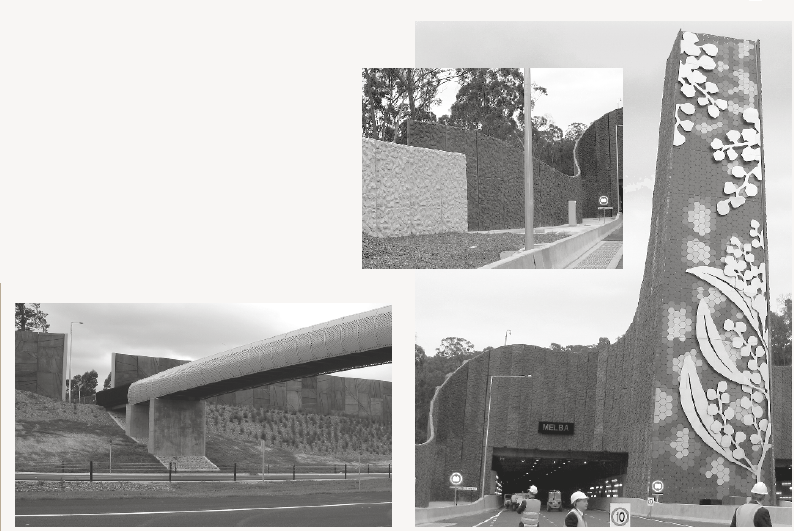
Figure 16. Pedestrian bridge, sound wall, and public art on EastLink. Major construction commenced in 2005, and the project was renamed EastLink. The project includes the following: ♦ 39 km (24 mi) of freeway-standard road ♦ Twin three-lane, 1.6-km (1-mi) tunnels ♦ 17 interchanges and 88 bridges ♦ Two toll-free bypass roads ♦ 40 km (25 mi) of shared-use recreational pathways Interesting Aspects of Procurement and Delivery CityLink, Victoria's first highway PPP arrangement, was procured in the mid-1990s and opened for service in 2000. Various lessons from the first procurement, as well as general experiences in the highway PPP marketplace, were incorporated into EastLink's procurement and delivery. ♦ Financial considerations: The tolling rate and structure were bid variables for the bidders to evaluate and propose for assessment by the government. Toll escalation was allowed annually, but not at a rate greater than the consumer price index. Bidders were required to share any excess revenues above that forecast with the government, and they were given the opportunity to improve the value of their offer by allowing the government to participate "in the benefits of refinancing."(g) ♦ Procurement considerations: The RFP emphasized various evaluation criteria, such as conformance with overall project, technical, and safety objectives; deviations from the established risk allocation framework in the contract document; and the quality of urban design elements. The concession period was also a bid variable to be proposed by bidders. ♦ Contractual considerations: The project was required to be open for service by November 2008. No restrictions were placed on general public transit or road network work by the state, but any state work deemed proximate (i.e., connecting to or within the vicinity of the project) could entitle the concessionaire to just compensation if net adverse impacts occur.(h) ♦ Performance considerations: An independent reviewer, complemented by a proof engineer and a construction verifier, would oversee administration of and compliance with the contract documents throughout design and construction and 2 years into operations. The proof engineer and construction verifier were introduced to provide additional technical scrutiny, particularly in the civil and tunnel works of the project. The RFP and concession deed also established KPIs in four long-term target areas: (1) customer service, (2) road maintenance, (3) landscape and environment, and (4) tolling accuracy. If performance thresholds are not met, the concessionaire may be at risk financially up to $17 million annually. Rather than pay the government, the concessionaire is required to distribute any such abatement amounts to EastLink's customer account holders in the form of toll credits. Project Outcomes and Status EastLink is Victoria's largest urban road project and PPP to date. The project opened 5 months ahead of schedule with no claims or significant issues for the state thus far. It also has the lowest per-kilometer toll in Australia at AU$0.11 per kilometer (2004 dollars). The project is noteworthy for its urban design features (as shown in figure 16) with attractive noise walls, pedestrian bridges, and public art. Fully electronic tolling has also produced innovation in tolling products and flexible approaches to toll collection enforcement. In addition, the project has achieved a net gain in native vegetation in the project area. Upon opening, the project had a 4-week toll-free period. Tolling began in July 2008. |
negotiations to scrutinize the fairness of such proceedings. Australia not only has closed but also has under construc- tion and completed some of the largest highway PPP contracts in the world. These practices and outcomes, as well as others, are simple illustrations of each nation's recognition of the significance of transparency to the overall credibility of a PPP program.
____________________________________________________________________________________________________________________________________________________
11 In some cases, the contract for the proposed project is included with the RFP.
12 External success fees are monies due to external entities contingent on contract award (i.e., bonuses for success).