Revenue Streams and Public-Private Partnerships
For public-private partnerships to be successful there needs to be a dedicated income stream. The most common type of revenue stream for highway projects is tolling. Virginia and Fluor-Transurban have agreed on High Occupancy Toll Lanes to be their primary source of revenue. Maryland has made plans to implement Express Toll Lanes (ETL) in certain parts of the state and has suggested using them on the Capital Beltway. A brief description of each system is provided below.
High Occupancy Toll Lanes. High Occupancy Toll lanes allow single-occupancy vehicles to use High Occupancy Vehicle (HOV) lanes for a user fee. The purpose of HOT lanes is to guarantee free flowing traffic conditions for those willing to pay for the luxury. HOT lanes expand travel options and help maintain traffic flow on existing general-purpose highways by operating alongside the existing general purpose lanes. To ensure safety, HOT lanes are separated from the general lanes and have their own entry and exit points and drivers do not have to merge into the general purpose lanes to reach their exit ramps.
HOT Lanes can differ in their access and user charges. For example, in some instances high occupancy vehicles cars are free to use HOT lanes while elsewhere HOV users have to pay. In other available pricing structures, operators may prohibit or charge a higher fee for single occupancy vehicles (SOV) or have variable toll levels depending on the level of HOV (HOV-2, HOV-3). In general, buses and emergency vehicles use the lanes free of charge.
Tolls in managed lanes can be fixed or vary with congestion levels. In a majority of the HOT lane projects in the U.S., the states use variable (or congestion) pricing to determine cost to the user. Variable tolling involves the use of advanced technology to continuously monitor traffic volume and speed in all lanes and automatically adjust tolls as a way to achieve targeted volume and speed levels. Drivers operating in these managed lanes use a transponder similar to the EZ Pass system to pay the tolls. A special function of these transponders allows the user to switch to the HOV mode and avoid user fees while operating in the HOT lanes.
Express Toll Lanes (ETLs). Express Toll Lanes are also a form of managed lanes, frequently referred to as variable, or "value" pricing. These lanes require all motorists, regardless of vehicle occupancy level, to pay a fee. Toll rates vary based on demand depending on the time of day or current traffic conditions and are collected electronically at full highway speeds. The major difference between ETLs and HOT lanes is that ETLs do not allow free or discounted passage of HOV vehicles regardless of occupancy, however they will still be available to mass transit at no charge.
HOT Lanes and ETLs. The U.S. has seen many successful examples of managed highway lanes in use. Examples include California's S.R. 91 and Minnesota's I-394. The lanes have delivered promising results with commuter timesavings, on-schedule bus service, and high levels of customer satisfaction. The S.R.91 HOT lanes experiment is four lanes stretching ten miles in Orange County. Tolls are variable based on the time of day; a ride can cost up to $20 per ten miles. California's S.R.91 Express Lanes facility was the first privately financed toll road in the United States in more that 50 years, the world's first fully automated toll facility, and the first application of value pricing in America.5 While expensive, Orange County, California, found that HOT lanes increased carpooling by 9.6 percent and saved drivers over 40 minutes of commute time. During a 2006 annual survey, California drivers reported an 85 percent satisfaction rate with these lanes.6
Minnesota has also had success with its HOT lanes on I-394 in the Minneapolis area. Upon recognizing underutilization of the existing HOV lanes, the state legislature moved to designate them as HOT lanes. During peak hours, the lanes function as HOT lanes but at other times are open for general use. In terms of cost, single occupancy vehicles pay the toll (the maximum per trip is $18) while the lanes remain free for HOV riders. Thus far, Minnesotans have responded favorably to the I-394 experiment and the legislature is currently looking at new HOT lane ventures in other venues throughout the state.7
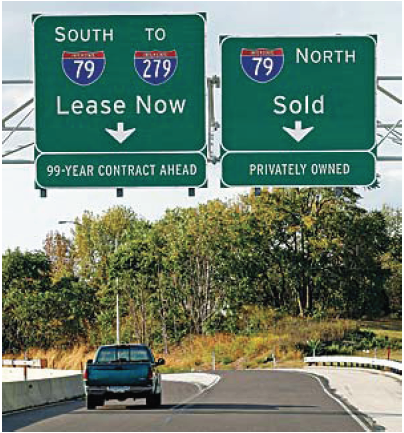
| Figure 2: Humor and Transportation PPPs
Source: Time Magazine, Joshua Lutz |