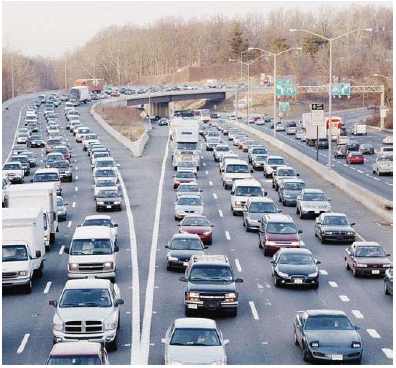
Beltway Congestion
Despite the 1977 expansion to mostly four lanes on the Inner and Outer loops, the Capital Beltway lacks the capacity to handle travel demand while drivers experience daily congestion marked by reduced travel speeds and significant delays. Inclement weather and/or accidents aggravate the congestion significantly.26 Virginia Secretary of Transportation Homer Pierce made the observation, "This [congestion] is a serious question being asked in a lot of regions around the country."27
The Washington DC Metropolitan area experiences the second worst traffic congestion in the nation28 as drivers spend an average of sixty hours a year stuck in traffic. Moreover, it is getting worse-the average travel time to work increased from 30.9 minutes in 1990 to 32.4 minutes in 2000.29 It is estimated that these hours have cost the region $5.5 billion in lost time and productivity.30 Commuters undergo more than 127 million hours of delays at a cost of $1,094 per rush-hour traveler and waste nearly 91 million gallons of fuel.31 This increase in travel time is due is due to both a regional population boom and a change in traffic patterns. Currently, the Beltway carries 180,000-240,000 cars daily and by 2025 the population growth of 32.4 percent will likely correlate to an increase of over 320,000 cars per day on the Beltway.32
Additionally, according to SHA accident statistics, the Maryland portion of the Beltway experienced 6,800 police-reported accidents during a three and a half year period between January 2000 and June 2003, resulting in an average rate of 58.1 accidents per 100 million vehicle miles of travel. The statewide average is 54.7 accidents for a similarly designed highway. According to the Capital Beltway Study website, Truck related accidents were also "significantly higher than the statewide average."33
The Capital Beltway's original purpose was to handle thru-traffic from I-95 around Washington, D.C. However, the Beltway is now a primary artery for traffic within the National Capital Region, including trips between major suburbs (witness the growth of Tyson's Corner, Rockville, and Alexandria as business centers). Indeed, the Beltway represents only three percent of the lane miles in Northern Virginia but accommodates nearly eleven percent of all daily regional trips. Montgomery County planning staff indicate that severe traffic congestion on I-495 will extend to nearly all hours of the day, with a 14-hour daily rush hour projected by 2020 (up from five hours per day in 1997).34 As designed, the Beltway simply cannot support the current traffic demands, let alone the projected traffic growth. | Figure 6: Beltway Traffic at the I-270 Spur in Maryland
Source: The Examiner, Baltimore, MD |