DOT Leadership Appointments
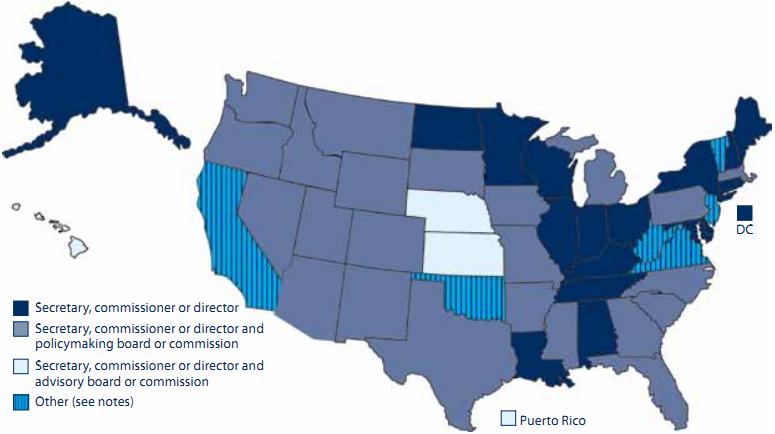
In most states, legislatures participate in appointing DOT leadership (defined here as both executives within a DOT and other transportation leaders within the executive branch that influence a DOT's activities). Leadership structures for DOTs vary, but most fall into one of four categories: those that are led by a secretary, commissioner or director; those that have one of these officials and a policy-making board or commission, either within the DOT (e.g., Kansas) or as a separate entity (e.g., Washington); those that have one of these officials and an advisory board or commission; and those that use another model (Figure 2; see also State Profiles and Appendix D).
|
Figure 2. DOT Leadership Structures
Notes: • California, Oklahoma, Virginia and West Virginia have a secretary, commissioner or director; a board or commission; and at least one other decision-making or advisory entity. • In addition to a Commissioner of Transportation, New Jersey has a unique, legislatively created Transportation Trust Fund Authority, the sole purpose of which is to finance the annual capital programs of the DOT and the New Jersey Transit Corporation. • The Vermont Transportation Board provides appellate review of various DOT decisions and rulings, has original jurisdiction over certain claims and conducts public hearings. Thus, although not solely advisory in nature, it does not have the policy-making function of many other transportation boards and commissions. • In Virginia, the Commonwealth Transportation Commissioner acts as the chief executive officer of the DOT. The state also has a Secretary of Transportation who serves as chair of the Commonwealth Transportation Board, a policy-making board that does not directly administer the DOT. Sources: NCSL-AASHTO Survey Data, 2010 - 2011; original research using Westlaw. |
Of these DOT leaders, the majority are appointed by an executive entity-typically the governor-with approval of the Senate. Selection of certain leaders in Mississippi and Utah is performed by a commission or board with Senate approval; New Mexico's secretary of transportation is appointed by the governor with the approval of both the Senate and the Transportation Commission.
Some DOT leaders, however, are appointed by the executive branch alone. At least some appointments in Alabama, Hawaii, Indiana, Kansas, Kentucky, Massachusetts, Nevada, New Hampshire, North Carolina, North Dakota, South Carolina, South Dakota, Tennessee and Wyoming are made by the governor with no legislative approval required. In New Hampshire, approval is required instead from an elected executive agency. Arkansas, Georgia, Idaho, Nevada, Oklahoma and Texas have leaders who are appointed solely by a commission or board.
At the other end of the spectrum are DOT leaders who are directly appointed or elected by legislators, including in California, Georgia and South Carolina. Pennsylvania provides an unusual example: Four legislative leaders serve on the Transportation Commission by virtue of their office. This commission reportedly provides greater oversight of the DOT than any legislative body in the state and creates a venue for an unusually direct interaction between the legislature and the DOT in the area of transportation governance.
Mississippi's unique three-member Transportation Commission is elected by the people and does not report to the governor. This is the only selection process of DOT leadership in the nation that involves neither the legislature nor the executive branch. The commission appoints the DOT executive director, however, with the advice and consent of the Senate.
Legislatures also may provide statutory guidelines for the appointment process and appointee requirements. Many states set statutory requirements pertaining to citizenship, residency, taxpayer status, party affiliation, geographic representation, experience, education or specific credentials. Colorado law encourages the governor to consider including at least one commissioner who is a person with a disability, has a family member with a disability, or is a member of an advocacy group for people with disabilities. Montana requires the governor to select one commissioner who has specific knowledge of Indian culture and tribal transportation needs, after consultation with the Montana members of the Montana-Wyoming tribal leaders council. Several states also have statutory prohibitions concerning conflicts of interest.
Legislatures also sometimes share the authority to remove DOT leaders. Although most serve at the pleasure of the governor or other appointing executive entity, at least Arkansas, California, Maine, New Mexico and Ohio provide for some involvement by the legislature in a removal process.