Review of Administrative Rules and Regulations
Legislative review of administrative rules and regulations provides another mechanism for oversight of DOTs. According to NCSL, an administrative rule "... is typically a regulation, standard or policy issued by an executive agency to implement statutory provisions administered by the agency. In many states, the number of regulations promulgated by executive agencies exceeds the number of statutes enacted by the legislature."17 Legislatures have delegated the responsibility to executive agencies to promulgate administrative rules, but in most cases retain authority to review and approve those rules so as to ensure that they comply with statutory authority and legislative intent.
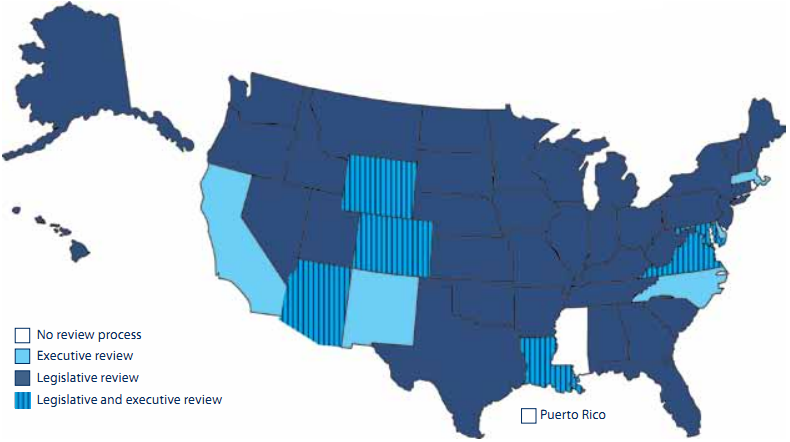
Forty-three states now have some form of legislative review of administrative rules (Figure 3), although legislative review is optional in Virginia. Mississippi, Rhode Island and Puerto Rico have no review process, while California, Delaware, Massachusetts, New Mexico and North Carolina have review by the executive branch only. At least six states-Arizona, Colorado, Louisiana, Maryland, Virginia and Wyoming-have review by both the legislative and executive branches. North Carolina's rules are reviewed by an executive entity, the Rules Review Commission, members of which are appointed by the legislature.
|
Figure 3. Review of Administrative Rules and Regulations
Sources: NCSL-AASHTO Survey Data, 2010 - 2011; the Council of State Governments (CSG), 2010; Erickson, 2010; Rhyme, 1990. |
In most states with legislative review of administrative rules, the legislature or a designated legislative committee has the power to suspend or supersede a rule. In Utah, all rules expire annually unless reauthorized by the legislature (see State Profiles). Several states limit the legislative review committee to a mainly advisory role, with the power to make recommendations but not to enforce changes. These states are Alaska, Arizona, Arkansas, Florida, Hawaii, Indiana, Kansas, Maryland, Minnesota, Nebraska, New Hampshire, New Jersey, New York, Ohio, Oklahoma, Oregon, Texas, Washington, West Virginia and Wyoming. In several of these states, a committee can object to or temporarily suspend a rule, but only a resolution or bill passed by the full legislature can veto one. In Vermont, if the Joint Legislative Committee on Rules votes to oppose a rule, it does not prohibit the rule's adoption but, rather, assigns the burden of proof in any legal challenge to the executive agency18