PROJECT SUITABILITY CRITERIA FOR PPP PROJECT DELIVERY
Experience from numerous transportation projects executed as PPPs suggest a number of criteria that both public and private partners deem critical to assessing the suitability of a project for development using a PPP approach and the likelihood of success for the PPP. The criteria listed in Exhibit 9 below should be used from the beginning of the project planning process to determine whether a project is suitable for a PPP and the kind of contract and project delivery arrangements would be most appropriate to the project.
Exhibit 9 - Key Criteria for Defining Projects as Candidates for Pursuit as a PPP
| • Legal authority and stakeholder desire - to use various PPP approaches • Demonstrated transportation need - congestion, safety, pollution, travel reliability • Sponsoring agency lacking resources - to fund or deliver the project on its own • Strong commitment by key stakeholders - political leaders (project champion), public agency officials, facility users, and the general public • Large and complicated project - warranting substantial private participation and assumption of project risks - generally over $500 million in construction costs • Adequate funding potential - tolls, availability payments, joint development, ROW • Strong partner relationships - competence and trust among members of the PPP • Level playing field for bidding teams - unbiased procurement process |
Exhibit 10 shows the four key prerequisites for undertaking projects using a PPP approach and the relative priority of each prerequisite. All four categories are important to the decision process, but institutional support requires legal authority, which requires on-going political support, which will only remain as long as there is support from the public and private stakeholders to the project. Key stakeholder groups include the general public, facility users, economic development interests, shippers, transit and environmental advocates, and the business community.
Public sponsoring agencies have their own requirements and priorities for determining whether to pursue a project through a PPP that include those in Exhibit 10 but extend to other factors. The same is true for private project delivery firms, as shown in Exhibits 11 and 12.
Exhibit 10 - Key Prerequisites for Undertaking PPP Procurements
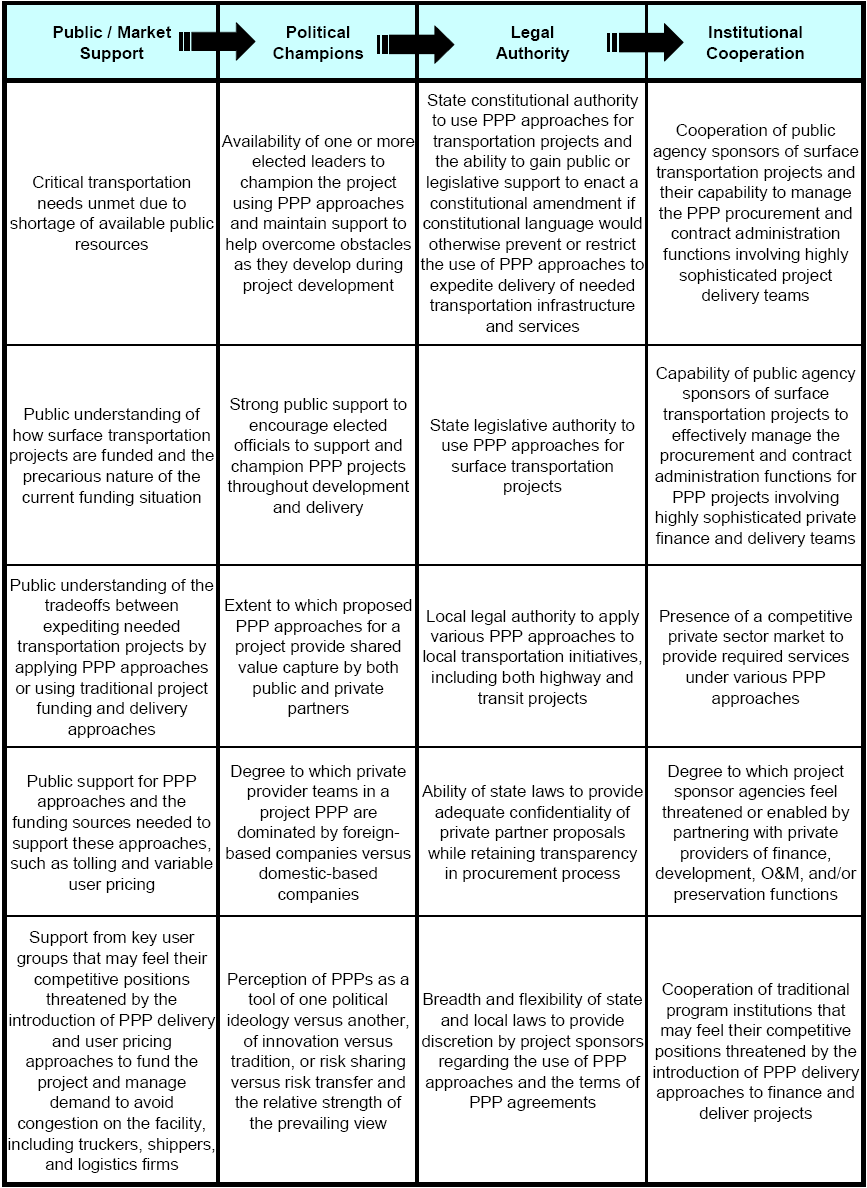
* Order of columns defines prioirty and prerequisites for successful PPP procurements indicated by arrows between column headings.
Exhibits 11 and 12 provide separate lists of criteria applicable to prospective public and private members of a PPP arrangement, respectively. These criteria are generally used by each prospective partner to evaluate PPP opportunities for proposed projects.
Exhibit 11 - Public Sector PPP Project Selection Criteria
| • Enabling legislation in place • Urgent transportation need • Political and institutional support • Lack of internal resources, staff/financial, to deliver project in a timely manner • Leverage public resources and transfer cost/schedule risks to the private sector • Expedite schedule through access to capital markets and innovative project delivery • Transfer cost, schedule, and quality risks to capable private partner • Increased cost-effectiveness through best practices and access to new technology • Competitive market environment based on firms with proven experience • Capability to manage transparent procurement/contract administration processes • Public accountability through monitoring of contract performance standards |
Exhibit 12 - Private Sector PPP Project Selection Criteria
| • Enabling legislation in place • Pressing transportation need • Reasonable development timeframe • Financially feasible (adequate funds to satisfy required rate of return on investment) • Manageable risks consistent with responsibilities and rewards as reflected in contract • Supportive political climate • Defined procurement path providing equal opportunity to all interested parties • Comprehensive market evaluation to assure reasonable traffic & revenue risks • Commitment to public sector sponsorship of environmental clearance and permitting • Commitment by public sector acquisition of necessary rights-of-way • Partnership philosophy demonstrated by project sponsor in flexible contract terms • Opportunity to apply innovative approaches to reduce project costs and risks |
In reviewing both public sector and private sector selection criteria contained in Exhibits 11 and 12, there is consistency in some areas while each side clearly has its own set of priorities. It is important for both sides to understand each other's priorities in evaluating projects as candidates for PPPs and determining whether to pursue them through some kind of partnering arrangement.
Exhibit 13 summarizes criteria used by prospective sponsoring agencies to determine if a project is suitable for delivery as a PPP project, such as project scale and level of public need. If the result is affirmative, the next set of decision factors help determine which type of project delivery and/or financing approach to pursue, including the development stage of the project, its risk profile, and the potential for funding from traditional and/or alternative sources.
Exhibit 13 - Project-Based Criteria for Selecting PPP Approaches
| Threshold Criteria for Considering PPPs | Decision Factors for Selecting PPP Approach | ||
| Project Scale | Public Demand | Project Stage and Risk Profile | Project Revenue and Funding Potential |
| Project size in terms of cost and financing requirements - the higher the cost the more likely the private sector will be needed to bridge the financing gap | Urgency of project to Satisfy transportation mobility need | Preliminary concept planning favors joint development and life-cycle PPP approaches that maximize potential for cost minimization and value capture maximization | Scarce public funding sources to meet transportation program budgets are enhanced by pooling multiple modal program resources |
| Project design and construction complexity - the more complex the design and the more sophisticated the financing the greater the potential role of private partners | Significant transportation-related economic development potential | Public sector takes responsibility for environmental clearance, obtaining most permits, and most right-of-way acquisition, including advanced acquisition | PPPs enhance ability of project to secure adequate financing and funding to support the project's developmental based on user pricing and/or economic development value capture |
| Project functional scope (whether financing and/or O&M are included) - the broader the more likely private partners can leverage public resources to meet the needs | Broad public support for PPP approach to project delivery, financing, and funding approaches used | Design is at less than 30% To optimize best practice input by PPP team | Legal authority must exist to Permit sponsoring agency to engage in PPPs that include use of private capital financing |
| Capability of sponsoring public agency not adequate to deliver project by Itself in a timely manner | Broad and sustaining political support for PPP approaches to leverage scarce public funds and expedite project delivery | Post-construction responsibility for O&M and preservation transfers significant project performance risk to the PPP team though O&M contract or brownfield long-term concession lease | Projects with high initial costs and long-range revenue potential require alternative financial approaches which can be more readily obtained through a PPP arrangement |
| Low risk tolerance of sponsoring public agency for large, complex projects | Presence of project in state or local transportation improvement plans (STIPs or TIPs) | The greater the risks of the project and the public sponsor's aversion to risk the more likely that a PPP approach will be considered | Projects that lack financial Feasibility will not attract private sector interest - therefore sponsoring agencies should not limit PPPs to the least feasible projects |