2.1 Background Information from Capital Investment Projects
Capital investments refer to those new type projects that require significant financing or capital for new bridges, expansion of road network, widening existing roads, or various types of safety and improvement features to the existing roads. These are typically outsourced to the private sector via various types of contracting agreements under the public tendering rules of each country. Countries in the European Union are required to follow the criteria in the EU procurement guidelines.
The Design-Bid-Build (DBB) or so-called traditional method has a strong separation between design and construction phases. The DBB method was essentially created around the time of the industrial revolution when the specialty fields of expertise of design professionals and contractors were developed and segregated from the integrated processes. The "Unit Price" contract (schedule of rates or bill of quantities) still seems to be the contract type developed under the traditional method.
This means that the contractor is paid based upon the unit price times the number of units put in place for each area of services or products delivered for that specific project. This requires a significant amount of administration and manual processes which can also contribute to potential conflicts. The quantities can be a source of arguments and lead to additional negotiations, as well as possible arbitration, if necessary.
Some countries are using the "Lump Sum" or "Fixed Price" contract for the traditional methods. This is essentially a total price for the entire construction work produced for that particular project.
Not until about the past 10-15 years or so, has there been a movement or trials toward more integrated contracts like Design-Build, Design-Build-Operate-Maintain, Design-Build-Finance-Operate, and the Build-Own-Operate-Transfer (BOOT) in the road sector. However, history reveals that some of the integrated contracts have been used in the past, but not as regular or normal part of most clients' strategy and practices. Pakkala (2002) lists the definitions of the different models. These so called integrated or innovative procurement models have been somewhat more common practice in the buildings sector or vertical construction industry, where there was a need for fast and integrated delivery methods. These similar drivers are being used and tested to deliver road projects. Other drivers include downsizing of many client organizations and a need for lesser administration by the client organizations.
Also, the private finance models, such as the DBFO (many times referred to as PPP) and BOOT (and their variations - BOO, BTO & BOT) models are becoming more widely used and the reasons vary from country to country. There are also other models similar to BOT and they are merely different financing, legal, ownership, and leasing arrangements. However, there is a common theme that arises, and that is the lack of public funding for road projects. Typically these projects are being delivered under the DBFO and BOT type models. The BOT type models have been used in a few road projects and are not a widely practiced as compared to other infrastructure sectors such as water, energy and power.
A new interesting model that has been used in some of the Anglo-Saxon type countries (UK, Australia, & New Zealand) is the "Alliance" model or the "Early Contractor Involvement" (used in UK). This will be discussed in more detail later as it is quite unique and requires further explanation. However, the Alliance Model attempts to solve some of the many issues in relationship contracting and boasts significant reductions of time consumed during the planning process.
The typical project delivery models available to be used for road projects are as follow:
• Design-Build (DB)
• Construction Management (CM At-Fee) - Rare
• Construction Management (CM At-Risk) - Rare
• Design-Build-Operate (DBO) or Design-Build-Operate-Maintain (DBOM) -Rare
• Design-Build-Finance-Operate (DBFO)
• Build Operate Transfer (BOT) & Build Own Operate Transfer (BOOT)
• Early Contractor Involvement (ECI)
• New - "Alliance model"
It should be noted that the Construction Management (CM At-Fee) and (CM At-Risk) are seldom used. These are very similar to the traditional model as the design and construction are still separated. These two models are being tested in a few countries, but there were no results to include in this report. CM At-Risk and At-Fee are mainly applied when there are some buildings involved, such as rest areas and other types of building structures. However, Finland had tested these models in the early 2000s', but did not have any good results or positive experiences that would have caused interest in continuing these models. So, the Finnish Road Administration basically discontinued these models and will not be a standard practice. Basically, these models are used when the client is so downsized or does not have significant know-how for managing projects. This is not the situation for most road administrations, and most road organizations have significant project management skills and know-how in administration and contract administration and management.
It is not the purpose of this report to recommend that any one model is the solution for all projects. Actually, quite the opposite is true in that it very much depends upon the unique requirements of a given project. On the other hand, there are factors that affect the choice for a particular procurement method.
• Project costs
• Political issues -in project selection
• Project size
• Degree of potential conflicts
• Available budget
• Degree of utility issues
• Degree of design development
• Client goals and objectives
• Project complexity
• Time critical elements
• Road market saturation
• Client flexibility
• Ability & competence of market
• Distribution of risks
• Environmental issues
• Construction management skills
• Legal & financial risks
• Ability of construction market & resources
Figure 1 shows the main delivery models and the integration of the planning process through construction and maintenance.
|
|
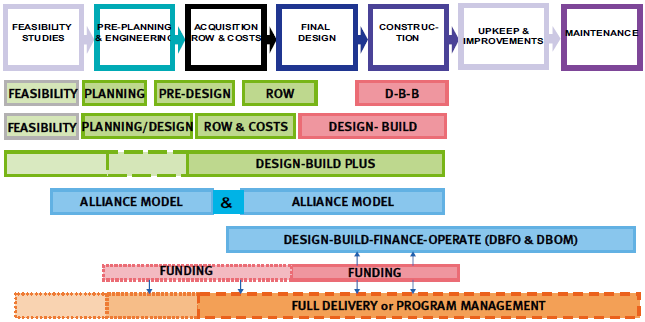
Source: Finnra (2003)
Figure 1 Main Project Delivery Models
Note that the Full Delivery or Program Management model has not been applied to any road projects and is more applicable to the building sector.