2.2.4 DBFO & PPP
Many refer to Design-Build-Finance-Operate (DBFO) model as the Public-Private Partnerships (PPP), but there are many definitions, forms, and variations of Public-Private Partnerships. However, in this report, PPP will be used synonymously as the Design-Build-Finance-Operate (DBFO) model (Finland uses the term "Life-Cycle Model"). The following definition is the first author's preference as it stipulates an arrangement that brings together the "Public Sector" and "Private Sector" in a long-term relationship or partnership, for the mutual benefit of both parties, with the "emphasis on long-term and ben-efiting both parties".
Many countries around the world are striving to answer the challenges in constructing and maintaining the transport infrastructure, which are important for the development of society. The recent trend in the lack of funding for capital investment projects has been a common problem for many road authorities. Most road authorities are lacking a road fund or earmarked funds and are dependent upon the typical year to year budget fluctuations and approval processes for new capital investment projects. Also for those countries that focus on "Preventative Maintenance" and outsourcing of maintenance for the entire or nearly entire road network, there are insufficient funds for development projects and meeting the needs of road expansion or widening. This is especially true for construction of large road projects and PPP is attracting the attention of many road authorities and from many countries not included in this study. More countries are now using the PPP model and Table 6 shows the PPP projects that have been completed or underway in the selected countries.
| COUNTRY | NUMBER OF PPP PROJECTS | COMMENTS | |
| ALBERTA CANADA | 2 | 2 more planned | |
| B.C. CANADA | 4 | ||
| Ontario canada | 1 | ETR- 407 Project - Auction (PPP under discussion) | |
| NORWAY | 3 | ||
| FINLAND | 2 | ||
| HOLLAND | 5 | 3 more planned | |
| ENGLAND | 12 | M25 DBFO London Ring Road in Tendering | |
| VDOT - USA | 1 | Dulles Greenway Project (PPP Under Discussion) | |
| Victoria Australia | 1 | Another BOT - East Link project under investigation |
Table 6 PPP Road Projects by Country
PPP projects vary with each country and England has tendered more PPP road projects that any other country. England has used the PPP model for over 600 different types of projects with successes as well as problematic experiences. However, the road projects have been quite successful and a report by National Audit Office (1998) summarizes the results of road projects as quite good in terms of "Value for Money".
Often the argument is raised that in some countries where the credit-worthiness of the state is very high (for instance, Finland which has a triple A rating), interest rates for the Ministry of Finance for loans at the capital market are lower than for private construction firms or consortiums. This argument is flawed to the extent that the state can be a reliable lender since it always has the opportunity to pass on risks and higher costs to the tax-payer.
Despite the successes in one country, it does not necessarily mean that PPP can be successfully implemented in all countries. England has led the way and other countries like Alberta and British Columbia - Canada, Finland, Holland, Norway and Virginia DOT (BOT) have reported good results for road infrastructure type projects. However, each country has differing cultural reference points and each country needs to decide whether the PPP model is appropriate for projects in their country.
A feasibility research study on PPP would certainly assist a great deal. It would be a very wise decision to thoroughly evaluate and conscientiously study all aspects of the PPP model for any proposed projects. There are so many dynamics involved and securing a project over a long-term period requires much research, wisdom, and a huge learning process for the client as well as the service providers.
It is very important to understand the concept of Design-Build which is the root of PPP. PPP basically means design, construction, maintenance, any operations, and private financing for a long duration, which typically is for about 30 years. If Design-Build has not been practiced or utilized in a country, it is very difficult to move from the traditional process straight into PPP. In other words, it is strongly recommended that one has some knowledge and experience of the Design-Build model and was doing it correctly, before proceeding to the PPP model. This may have a significant effect on whether PPP will produce the highly publicized benefits that have been reported in many publications. It is possible to move directly from the traditional model into PPP and some countries have done this, but the results will not be as beneficial had the lessons learned from Design-Build been implemented in the past.
The illustration in Figure 2 shows the project delivery methods typically used for road projects and also shows the stages of progression from one model to another. Usually, it requires some form of development, research, studies, experience and etc. before moving to the next progressive model. It is easy to visually see and understand from this figure that it is quite difficult to move directly from the traditional model directly to the DBFO model. The experience of testing and implementation of any models in between can be considered as a learning process. This will help alleviate any possible difficulties and lack of experience when the DBFO model is attempted. Any valuable experiences learned from those models will make adaptation quicker and more beneficial.
Additionally, it is very difficult to describe the maintenance related requirements portion of a DBOM or a PPP contract, if one has never outsourced maintenance in the past or had any experience in specifying contracts for maintenance. In practice it is difficult to determine maintenance outcome type criteria, service levels, risks and many additional aspects if they have never been done in the past or scoped in any contracts. It is much easier to use existing maintenance contracts and translate the maintenance requirements into a PPP agreement (about 20-30 years), when one has acquired experience in outsourcing maintenance and realized the lessons learned and best practices.
Since PPP involves private finance there are many aspects of private finance that need to be considered before undertaking such a progression forward. For example there needs to be legal verification that private finance can be used. For example, in the USA the Federal Highway Administration (FHWA) adopted SEP-15, to provide more flexibility to the states to have early involve-ment of the private sector in projects likely to use PPP's. Also, other countries may require some type of legal approval or authorization for private finance.
|
|
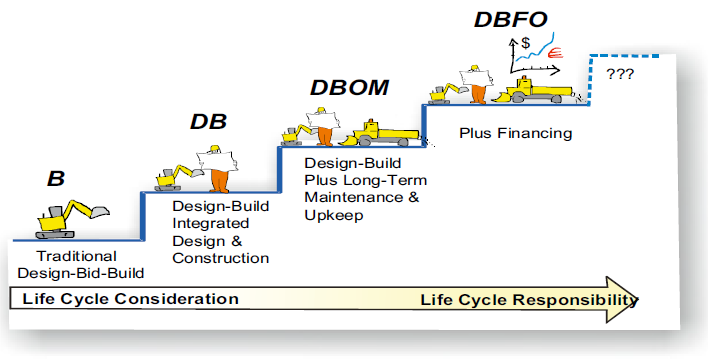
Source: Finnra (2003)
Figure 2 Project Delivery Progression