2.2.5 ALLIANCE MODEL
As mentioned earlier, a recent newer model has been identified as the "Alliance Model", which has been utilized for road projects. This model has been used in Victoria and Western Australia, New Zealand, and England. In England it has been termed as the "Early Contractor Involvement (ECI)" and to the best knowledge it is quite similar to the Alliance model. It is quite difficult to define the Alliancing Model in brief, and it might be easier to understand "Alliancing" by describing the features of this model. In the Alliance Model the selection of the winning alliance in the tendering process is based upon the alliance team that is best capable to bring a project to completion. In other words the alliance team is selected by 100% "Quality Criteria". The winning alliance will be able to bring the remaining portion of the client's design/planning process and develop it until a "Target Price" can be determined for the project construction. This means that the winning alliance has the obligation to complete a project from the very early design/planning phases right to project completion, and is paid all costs (including profit & overhead) up to the "Target Price" for construction. Depending upon the performance against the construction "Target Price" estimates, there can be a maximum of 15% shared bonus or shared penalty by the "Alliance Partners". Also, there is potential to receive a so called "extra bonus" for exceeding the "Key Result Areas or Indicators" (game-breaking performance), that are agreed to by the alliance. The client is also a member of the alliance team. Figure 5 shows the Northern Gateway Alliance organizational structure.
In Ross (2003) the Alliance model is a form of cooperative contracting model that contains most of the following features.
• Two or more parties (usually client/owner, designer, contractor, possibly a key professional consultant - environmental, and maybe a strategic supplier) that are confined in a single agreement and are known as an "Alliance Partners"
• The performance targets are collectively agreed upon versus individual decisions
• Payment to the non-client/owner participants by:
• 100% of all work including project overheads
• A fixed lump sum to account for overheads and profits
• Equitable sharing of "Pain & Gain" as compared to the agreed "Target Price"
• Express commitment to resolve issues without litigation - cannot sue (except for willful default)
• Transactions by all parties are "Open Book"
• Governed by an Alliance Board and all decisions must be unanimous
• Managed by an "Integrated Project Management Team" chosen on basis of "best for project!"
• Agree to commit to agreed set of "Alliance Principles"
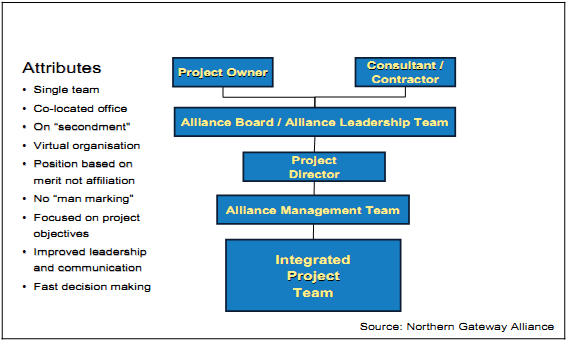
Source: Northern Gateway Alliance (2006)
Figure 5 Northern Gateway Alliance Structure
Typically this "Alliance Model" is chosen very early in the planning process and preferably tendered as soon after any feasibility study is completed, in order to utilize the competence, leadership skills, innovations, and problem resolution skills of the alliance team to maximize the benefits of "Value Engineering". The Alliance model can almost be considered as a "leadership model" as it requires the superior people and leadership skills at many levels within the alliance. Some of the drivers and reasons why an alliance might be used are listed as follows:
• Complex projects and interfaces
• Scope changes can be collaboratively managed
• Potential to lower overall costs - via efficiency, collaboration, & innovations
• Planning and project construction can be significantly reduced
• Desire to achieve outstanding results
• Superior problem resolution due to collaborative structure
• Usually better quality
• More aligned to public values
• Better risk management - collectively managed
• Additional focus on Life Cycle Costs (LCC)
• Motivation for best practices and results
Koppine n & Lahdenpera (2004) reveal some of the benefits and disadvantages of the "Alliance Model". Table 7 highlights these benefits and disadvantages.
| METHOD | BENEFITS | DISADVANTAGES |
| Alliance | • Better risk sharing • Lower bidding costs • Clear identification of service requirements • Whole-life focus leading to a better quality product • Better value for money through better customer focus • Enhanced efficiency and innovations • Client has more control over the project delivery • High flexibility • No claims • Earlier and accelerated delivery • Industry development • Cost-certainty • Time-certainty • Better problem resolution • Higher trust between partners | • Difficult to determine that pricing is competitive • Lack of suitable skills in government agencies & leadership qualifications • Resistance to change • Uncertainty of process & model • Dealing with Environmental Approval • Client roles are mixed - potential decrease in transparency toward the public (authors addition to list) |
Source: Koppinen & Lahdenpera (2004)
Table 7 Alliance Model Pros & Cons
There are bonuses or potential for incentives providing that there is some type of breakthrough innovations, exceeding key performance requirements set out by the alliance, or meeting some extra special targets within the project. Some of these attributes that bring forth this so called break-through performance are highlighted in Figure 6.
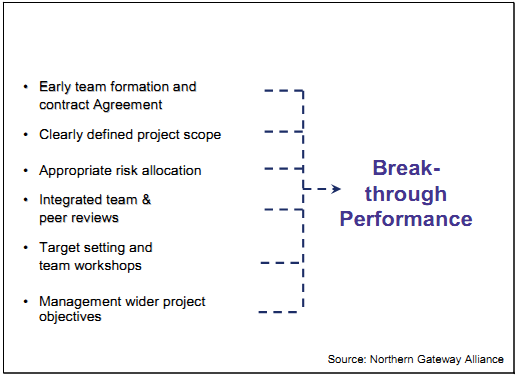
Source: Northern Gateway Alliance
Figure 6 Break-Through Performance
One essential aspect of the model is the "Target Price" portion. The Alliance Team brings forth the project scope, design, and planning issues until a target price can be determined. Once the target price is verified by external experts and agreed to by the alliance team, the construction portion begins to occur and progresses until project completion. Once the project is completed, the target price is verified against the actual invoices (Target Outturn Costs - TOC) for the construction portion. The so-called "pain & gain" is now determined to verify the performance of the agreement against the target price. Figure 7 shows how this is determined and how the basic calculations are performed.
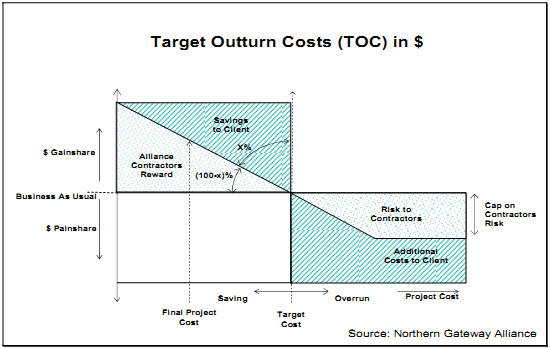
Source: Northern Gateway Alliance
Figure 7 Pain & Gain Determination
The extra value that the "Alliance Model" is expected to deliver can be considered as follows:
• Exceptional quality
• Smooth delivery process
• Better environmental considerations
• Super fast delivery (Planning process time savings is major portion)
• Superior problem resolution
• Equitable cost/profit sharing
• Greater innovation potential
• Optimized value engineering
Results from the interviews have indicated favorable quality, better environmental solutions, on-time completion, and costs higher than traditional models (does not take into consideration the potential savings of the client's own planning associated expenses). However, many of these projects are on-going and not enough data exists to make any conclusions about the "Alliance Model".