2.3.1 PROFESSIONAL SERVICES SUMMARY
It should be noted that England uses the framework model for selection of professional services for a long-term duration. This is quite unique and seems to be an "Anglo Saxon" practice that is designed to save time and tendering costs. Framework type contracts in England are not only used for professional services (design & planning), but are also used for bridges and resurfacing contracts. The main ideas of framework contracts are to reduce the amount of time for tendering, select tenders quickly for urgent projects, and reduce overall administration time and costs. Essentially the tendering process is to short list to about a maximum of 5 service providers that will be given projects based upon the skills and cost provisions, at the discretion of the client team. Prices are evaluated against so-called "dummy schemes" and there are criteria to measure past experience and competence of work. Those service providers are then provided first consideration and these service providers are given projects on a rotational type system and on a negotiated type basis. In essence this means that once a service provider obtains a work order, then the next service provider receives the next assignment, and so on, until all have received an assignment. Then if more projects are needed the rotation begins again.
Ontario and Alberta Ministries of Transportation in Canada, have similar concepts, but are quite different than "Framework Contracts". Ontario MOT uses a system, which is termed "Total Project Management" (TPM) in which the various phases of Figure 8 are procured in a single contract. Alberta, Canada has a similar type concept that is referred in their Project Administration Manual (PAM). This concept can be seen as an attempt to be innovative and retain the knowledge, learning, competence, and continuity throughout the planning and development phases of a project. Also, the Canadian Provinces in this study (British Columbia, Ontario and Alberta) use a "Professional Services" rating system which affects the ability to win future contracts for "Professional Services" as it is a part of the tendering criteria.
Also, a few countries even require a separate professional services contract to complete the final design, when it is a traditional type contract (Design-Bid-Build). This is becoming more obsolete in the most progressive countries and is not a standard practice.
Table 8 shows some of the practices for professional service contracts and what phases or services are typically outsourced. This table shows whether design development and engineering are outsourced or done by their own design/engineering experts (in-house). Also, the table shows if there are any combinations of these services and if these services are included in a single agreement or bundled together. The objective is to determine if professional services are procured in an integrated fashion, where there is cohesion and continuity throughout the entire design development phase. It is beneficial to retain the same professional services organization during design development to avoid necessary duplication of efforts and continuity of the process and reduce relearning. There would be a potential to reduce errors and omissions with the integrated approach.
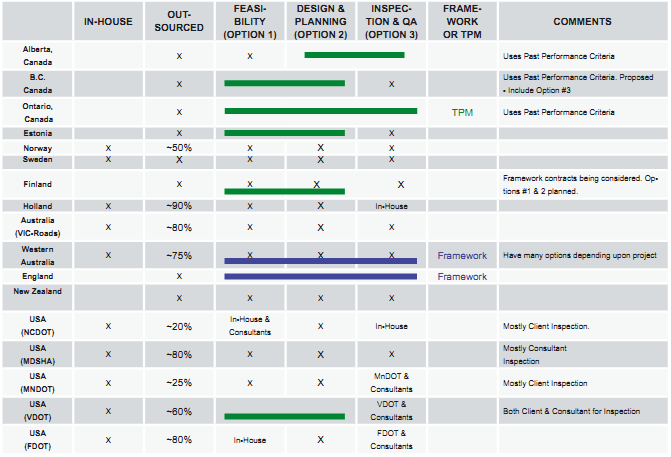
Table 8 Professional Service Contracts Comparison
Total Project Management - TPM (includes all options in one contract) QA Quality Assurance