3.1 Background Information
Maintenance is usually one of those practices that do not receive much attention, recognition, glory, or interest amongst the decisions makers until something goes wrong or if safety is compromised. Sometimes maintenance functions are not a significant priority for some road authorities which may lead to budget reductions, lowering the Levels of Service (LOS), and reducing the satisfaction levels of the traveling public or road users. In cold climate countries such as Scandinavia and Canada, winter maintenance is an important part of maintenance as it has a potential to become a safety issue or can cause accidents when roads are not maintained at proper service levels. In other countries the main concern is with pot holes, excessive road roughness, bumpiness, texture, and other non-desirable conditions that affect satisfaction from the road users. Most countries are using some form of customer service audits (road charters) to determine if the roads are in satisfactory condition, to assist in determining the customer satisfaction perception. Also, customer satisfaction surveys can become one tool to determine results of any outsourcing practices and determine if the perceived quality of service is increasing or decreasing.
Over time, the attitude towards maintenance has changed somewhat and is becoming more of an issue and important aspect for taking care of the road network. Maintenance is also a new market for the private sector in those countries that outsource maintenance. Recently, there has been a focus or strategy in many countries for pavement preservation, asset management, and taking care of the existing road network as a first priority. This is true especially in some of the European countries and a few of the Anglo-Saxon countries where the actual road budget is determined by investing in maintenance as the first priority, and what is left in the budget is then applied to other needs or capital investment projects. Maintenance has gained more attention in Finland, for instance. In Finland the road budget is prioritized by winter maintenance, second is routine maintenance, then periodic maintenance and the remaining is applied to capital investment projects.
Routine Maintenance
Routine maintenance can be defined by those maintenance activities that occur every year on a routine basis or of a cyclic nature. These activities may include such aspects like winter maintenance, summer maintenance, pot hole patching, minor gravel road repair or patching, minor drainage cleaning, road cleaning or sweeping, crack repair, vegetation control, cleaning (signs, bridges, roads), and trash removal. Figure 10 shows the difference between routine and periodic maintenance aspects and typical shows how they can be organized in a typical outsourced contract.
Periodic Maintenance
Periodic maintenance can be defined as those activities that occur infrequently or every so often and can be termed as "upkeep and improvements". Throughout the history most periodic maintenance tasks have been typically tendered as separate contracts and can include such activities as resurfacing, bridge habilitation/reconstruction, safety improvements, and other major improvements. Figure 10 shows some of the differences between routine and periodic maintenance, as well as those activities that are typically procured via separate contracts. These vary between countries and some even inter-mix the activities within routine or periodic maintenance. This is not a significant issue as to what activity is used for routine or periodic maintenance, but the most important issue is to what works best under the specific culture, environment, local market, and which practices delivers the best value to the road authority.
|
|
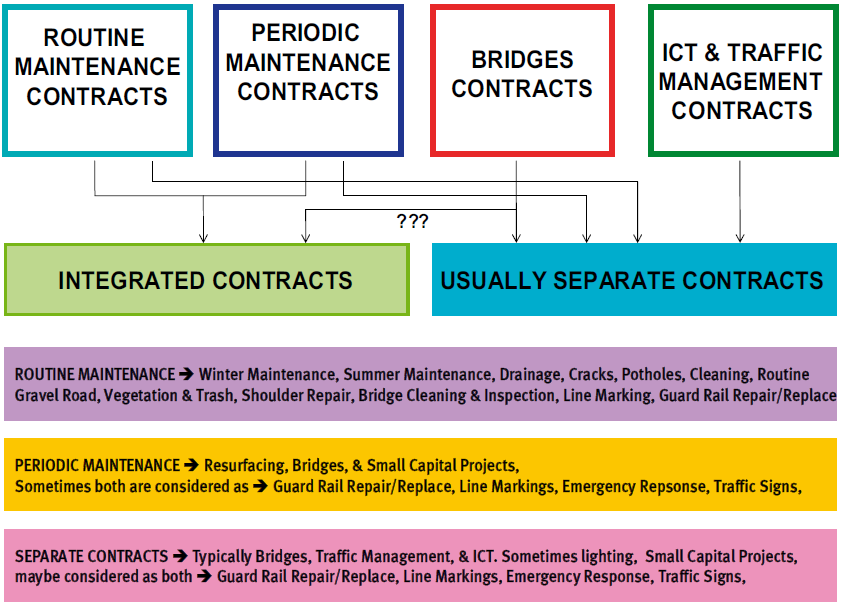
Source: Pakkala (2006)
Figure 10 Routine & Periodic Maintenance
??? - Bridge rehabilitation is seldom used in maintenance contracts, but option is available
Typically throughout the history of most road authorities, resurfacing type contracts have been tendered via separate contracts and are usually considered as periodic maintenance or "upkeep and improvements". Even in the past some of the resurfacing practices were done by "in-house" or own works, and sometimes used combinations of outsourced and self-performed, depending upon resources and budgets. Recent outsourcing and development trends in some countries have resulted in the integration of surfacing activities that are included into the maintenance contracts. However, most countries typically tender the resurfacing activity as a separate contract. By integrating the resurfacing portion into the maintenance contract, it was expected to achieve better results for the road authority.
Another objective of this study was to determine if there have been any trends or movements towards separate long-term resurfacing contracts that had warranties of over 10 years. PIARC (2002) article provided a few examples from Quebec, Canada and South Africa that included an extended warranty included in the resurfacing contract. Since then, there have been very little developments and news about these long-term pavement warranties and this study was to evaluate the situation in these target countries. This topic will be addressed in the resurfacing results section.
Also, it was desired to determine the latest status and developments with Pavement Management Systems (PMS) and to determine if there have been any further achievements and innovative solutions. Many countries seem to be using the latest automated equipment and technology to gather road condition data for the inputs into the PMS to determine a strategy for which roads need to be resurfaced. Tradeoffs or optimization tools can be used to determine a resurfacing strategy according to the available budget.
PMS systems are used and appear to be continuously improved in order to achieve better decision making by the road authorities. Some progressive countries even have developed performance criteria and indicators that indicate how well the resurfacing goals have been achieved. This development has not fully matured, but these practices and concepts are in process in many countries. The "Anglo-Saxon" countries seem to be the fore-runners in this practice. Some of these concepts are discussed in Section 4.0 called "Performance Indicators", but are usually used by the road authority to assist in developing better road management practices. It should be noted that these developments are not specifically used in the contracts with the service providers, but performance indicators are used as a management and accountability tool.
Other impacts include budget fluctuations that road authorities experience, the recent oil price increases, and greater amount of roads that need to be resurfaced. These have caused concerns to the road authorities because the vision and goals are to take good care of the existing road network. Since many road authorities are struggling with these recent budget deficiencies, caring for the existing road network can cause compromises. Optimization of the PMS can assist in making these tradeoffs. This issue has been confirmed in many countries, where there are insufficient funds to maintain the entire road network at normal standards and often report the amount of deficient or unsatisfactory roads.
There are similar issues with the bridges in Finland as well as several other countries, and bridge conditions are becoming a concern too, but this study did not evaluate bridge contracts. In Finnra (2006) the condition of the bridge network has been decreasing on a yearly basis and needs extra funding due to the large number of bridges due for rehabilitation. This is a common situation amongst most of the countries in this study. Bridge contracts are so specialized and usually administered in very traditional ways.