3.1.1 ROAD REFORM AND ROAD DEVELOPMENT BACKGROUND
One of the main drivers for maintenance contracting practices has been the issue of "road reform" or "road development" or even known as the "Client/ Producer model". A majority of the countries in this study has experienced a similar process or at least has relinquished performing actual physical works of maintenance activities. They have sort of become contract managers because most if not all works are publicly tendered. Not all countries have gone through this process and these include USA, Victoria (Australia), and Estonia. Sweden tenders all these contracts, but their "Vagverket Produktion" is a business unit still inside the Swedish Road Administration and full transparency has not been achieved.
The following example from Finland will highlight the "Client/Producer model" concept and as an example of how road development has progressed and can be an example for others. Finland has quite extensively followed the "New Zealand model" of road reform and from guidance material from the "World Bank" list of recent practices. The following highlights the progression and brief history of developments in Finland.
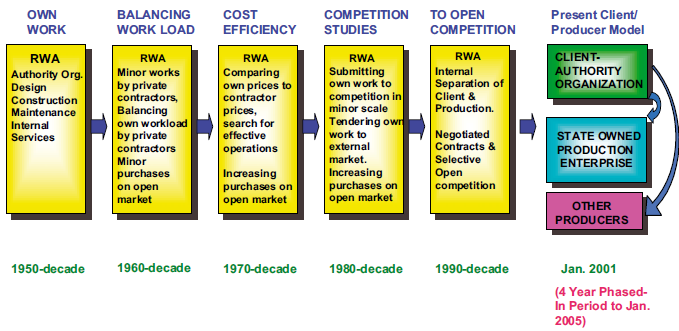
In Finland, the Finnish Road Administration (Finnra) is the governmental agency responsible for the management of the public road sector. Before the 1960s Finnra kept all maintenance aspects with their own work force and in-house capabilities. Since the 1960s Finnra began purchasing various activities and services such as winter maintenance for lower volume roads and grass mowing. These types of practices continued and increased throughout the decades and were a "stepping stone" toward outsourcing the entire road network. As a result of these practices and slowly opening activities for the private sector organizations, this has made it possible for Finnra to place more and more activities to the private sector. Today all routine maintenance and periodic maintenance are outsourced via open public tendering. Routine area maintenance contracts for the public road sector began open competition in January 2001, and continued gradually via a four year phased-in transition period through the year 2004. Fully and complete open public competition was achieved in January 2005. Other countries have followed similar processes and this is sometimes called road reform or as the "Client/Producer model". Road reform in Finland is one interesting example of how outsourcing can be successfully achieved via diligence and good management practices and implementation. As mentioned previously, Finland did have a model to follow and some of the same development and procedures from New Zealand were pursued and adapted. Finland did not stop there and has continued to develop its procurement practices and good practices and boldly continue along the innovative path. As a result, Finland has achieved significant savings, awards, and has been closely followed by other countries. Even Norway has also implemented the "Client/Producer model" into its practices in January of 2004. Salminen & Viinamaki (2001) highlight some of the objectives, issues, benefits, and struggles in transforming a public agency.
Some even consider this as a form or process toward privatizing a portion of the government organization. This has been the Finnish model for many such organizations in the past and appears to be model that has proved satisfactory. De Jong (2002) also analyzes the movements and changes in the Nordic countries and has shown that Finland has had a successful process.
Figure 11 shows the development stages of Finnra since the traditional in-house, production work force.
| Development Steps of Finnra |
|
|
Source: Finnra (2004)
Figure 11 Development Steps of Finnra
Finland has followed global developments which have led to the interest and desire for more integrated and longer term maintenance contracts. Some countries have used performance-based maintenance contracts for a long-term, and include many aspects of routine and periodic maintenance activities as part of the agreement. This has been seen as an interesting and unique approach and has sparked the interest of Finnra to investigate and adapt long-term, performance-based maintenance contracts into the strategy. We can refer to Finnra (2003) which shows the development of the maintenance contracting strategy. Also, Finnra has not stopped there and continues to follow global and innovative practices in maintenance contracts and are presently renewing their maintenance strategy. Finland is not the only model to follow, but merely one possibility model or example to follow. England and other Anglo-Saxon countries have implemented more integrated contracting forms.
The Finnish model of development can be seen as an effective and highly recommended process that gradually outsourced routine maintenance activities until the present client-producer model was achieved. This has made adaptation relatively easier to implement. However, change is never easy and it should be understood that approval is needed at high levels of government, key champions for the process, diligent effort, and much diffusion of knowledge and expertise from the client organization to the private sector. One key and challenging aspect for road authorities that have outsourced the maintenance activities is the ability to transfer public values to the private maintenance contractors.