Maintenance Practices
During the earlier years of procurement of maintenance activities and during the first transition to outsourcing, the services were purchased yearly or via multi-year agreements, using separate contracts for each activity, and usually with a labor rate or unit price. Next, performance-based routine maintenance contracts began with 3 year contracts with service levels for quality standards and were typically unit price or hybrid contracts. The next progression was to longer and more lump sum type contracts. More recently there have been more integrated contracts (periodic and routine maintenance), for a longer duration, basically lump sum contracts, using performance criteria or Levels of Service (LOS), and using more of a partnering concept. Table 12 in the maintenance section of this report shows a summary of the different maintenance practice used by the countries in this study.
Figure 23 shows the international development of maintenance practices and is still the development trend in today's maintenance practices. In short the results from this study continue to verify this trend of development and continue to be a valid strategy that many continue to follow. British Columbia, Canada has somewhat pushed the development as compared to the similar study in 2001, and all the routine maintenance contracts are of 10 year duration.
The main message is to understand that it probably will require a long and deliberate process to advance from the in-house model (traditional model) directly to fully performance based routine maintenance contracts. There are so many development issues and concerns for implementation and it would be wise to progress deliberately along the upward slope of Figure 23 to the more progressive models.
The main new development is the inclusion of the "Alliance model" or what is termed E-MAC in England. This is a recent development and appears that this is a potential replacement of the Performance Specified Maintenance Contracts (PSMC) type contracts in the Anglo-Saxon countries. Also, it was noticed that the results from these PSMC type practices have not been as expected and the "Alliance Model" is being investigated as a potential replacement for PSMC.
|
|
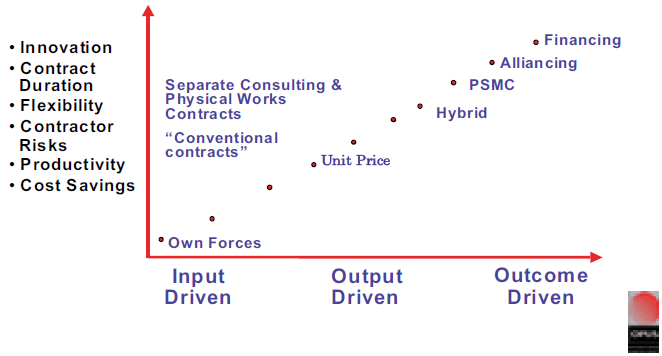
Source: Porter (2001)
Figure 23 International Maintenance Development
In summary the following highlights the development of maintenance contracting:
• Opening the market to maintenance has been key issue and a deliberate process of development should be considered before advancing straight towards the advanced models (Figure 23)
• Outsourcing of performance-based routine maintenance has demonstrated successful results
• Longer-term agreements - about 7-10 years
• Lump Sum or Hybrid type contracts (Combination of Lump Sum and Unit Price)
• Using quality-based contractor selection methods
• Most innovations have been equipment related, ICT, and Project Management
• Alliance model appears to have good potential
• Partnering and trust are still relevant (both Client & Sub-Contractors)
• Integrating periodic maintenance with routine maintenance is suspect and should be cautiously considered
There are many national and international lessons to be learned and under-stood when progressing to the advanced performance based maintenance models. There are so many considerations to be taken into account and it is wise to study the developments, lessons learned, affects of outsourcing, possibly changing the market, and a paradigm change especially for the road authorities. Change is difficult (especially for public organizations), but it is necessary in keeping pace in today's society and the desire to progress into best practices that produce better services at a fair investment.