A. WHY ARE PUBLIC-PRIVATE PARTNERSHIPS IMPORTANT?
The transportation needs of our nation continue to outpace our ability to respond to them through traditional public means. Our infrastructure is aging-much of the Interstate System is over fifty years old. At the same time, congestion is increasing-according to one study, commuters spend 62 hours per year stuck in traffic, costing our economy over $67 billion a year.1 Our highway system is now operating beyond the capacity for which it was designed.
Despite the incontrovertible evidence of growing need, the funding available for highway and other transportation facilities has not risen at a corresponding rate. Projected Federal, State and local highway revenues are insufficient to meet estimates for future highway investment requirements. Investment requirements to cover operating and maintenance costs, and to make capital investments that would maintain current highway conditions and performance are 40 percent greater than projected revenues. See Figure 1.2
Figure 1 : Comparison of Projected Highway Revenue with Investment Requirements
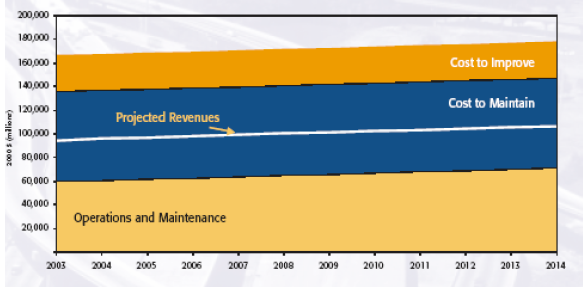
Real highway revenues (adjusted for inflation) are declining relative to the growth in vehicle miles of travel (VMT). Both highway condition and performance are directly related to VMT. If past trends in revenues per VMT continue, State and local governments will fall further behind in highway conditions and performance.
To address this widening gap, we are going to need to find new ways to finance, construct, and operate highways. These new ways must focus on solving the problem of congestion on our current highway system, whether through the construction of new facilities or through more effective use of existing highways. Successfully managing congestion will reduce delays that cause our current system to be inefficient and, at times, to fail. Congestion management can reduce commute times, improving quality of life. It can increase the economic productivity of our highway system allowing goods and services to be delivered in less time and at less cost.
Public-Private Partnerships have the potential to play a significant role in providing a real solution to the problem of congestion. Public-Private Partnerships can provide additional sources of funding that may allow needed transportation projects to be built. They can save time and money through innovative ways to finance and construct highway projects. They can be a means to more efficiently allocate risks between the public sector and the private sector. They may also provide a way to more effectively price current and future highways so that the public uses the highway more efficiently.
____________________________________________________________________________________
1 See generally, Texas Transportation Institute 2005 Urban Mobility Study, available at http://mobility.tamu.edu/ums/.
2 From Highway Finance and Public-Private Partnerships-New Approaches to Delivering Transportation Services, January 2005, published by Federal Highway Administration, Publication Number FHWA-HOA- 05-003, p. 5.