CASE STUDY 1
CASE STUDY 1 | ||||||||||||||||||||||
Heavy Equipment Transporter (HET)
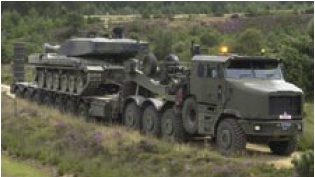
The UK Heavy Equipment Transporter fleet comprises 89 Oshkosh 1070F Heavy Equipment Transporter vehicles (pictured) and 3 Hitch Recovery Systems.
|
The contract is delivering the specified service and the equipment has provided a front line capability
4 The contract for the Heavy Equipment Transporter project was signed in December 2001. The service was subsequently delivered ahead of schedule in order to meet operational deadlines for usage in Iraq. The Heavy Equipment Transporter and its operators have also served in front line operations in Afghanistan.
5 The Heavy Equipment Transporter project was a pathfinder for the use of Sponsored Reserves. Sponsored Reserves are individuals whose employers are contractually committed to provide specific operational capability to the Services. During front line operations these personnel are called up and serve as Army Reservists alongside regular Army personnel. This was identified as an area of potential risk and three standard bid options were developed, with differing proportions of the service delivered by Army personnel and Sponsored Reserves in each. The bidders addressed all three options separately in their bids. By including different options, the project team could better assess the impact of this risk on the eventual contract price and decide which offered best value for money.
6 There are currently 85 Sponsored Reserves employed (68 Heavy Equipment Transporter operators, nine maintainers and an additional eight in reserve). Although there were some initial misgivings about the use of Sponsored Reserves and problems with their integration into regular squadrons, it is felt that these have been overcome and that Sponsored Reserves have been a success.
The Department has had some difficulties meeting its contractual obligations and the scope of the contract may need to change to meet future need.
7 In some instances the Department has used the equipment in a manner that has led to it accepting additional risk
■ In the current operational theatres, temperatures fall outside of the design specification and the roads are not always of the condition specified in the contract. When the Heavy Equipment Transporter is used outside of contractual specifications, the Department is liable for any damage incurred, or repairs required.
■ Future heavy vehicles that were not in the original scope of the project such as Trojan, Titan and the up-armoured Challenger II may fall outside of the contractual weight limit of 72 tonnes if carried by the Heavy Equipment Transporter. Although the Heavy Equipment Transporter is likely to be capable of handling such loads, the impact on the vehicle will need to be assessed and risks considered.
■ The weight capacity is also restricted at the lower end with a minimum weight limit of 25 tonnes. This is because light vehicles are currently carried by a separate fleet of Light Equipment Transporters. This does not mean that risk will be transferred back to the Department but it does reduce flexibility. It would not be cost effective or beneficial to the environment for using Heavy Equipment Transporter to move small loads but there are some at the margins of the 25 tonne limit that would be practical to be moved in such a way.
8 It is not possible to say in these cases that the contract should have included provision for this uncertainty, since this would have increased the price of the contract. In the case of usage in operational theatres, it is appropriate that the Department should retain complete control over how the asset is used. However this does illustrate that the Department needs to be aware as far as possible of future developments when selecting the most appropriate procurement route - although these can be difficult to predict. It also illustrates the need for effective change mechanisms within PFI contracts.
Risk transfer is successful but the Department needs to continue to manage future threats to value for money
9 Risk management is undertaken on a joint basis, although the current risk register originated from the contractor and was added to by the Department's project team. The project team should regularly review these risks to ensure that they accurately reflect their assessment of the current risk profile and that mitigations are in place to protect the Department's interest.
10 One specific risk that will need to be managed is the impact of latent defects arising as a result of usage outside the contract specification. These may not materialise until a later stage in the contract. At the current time latent defect risks lie with the contractor, however disputes may arise if the contractor can show that defects were directly caused by usage outside of the original contractual constraints. In any event, any factor that affects the ability of the contractor to provide the service will impact on the user, regardless of who bears financial responsibility. The project team and contractor will need to work together to ensure that this risk does not impact on the provision of the service as the contract matures.
11 The project teams will also have to maintain the current effective working relationships when the Department's team managing the project moves from Andover to Abbey Wood near Bristol. This has occurred as part of the formation of the Defence Equipment and Support organisation (DE&S) from the Defence Logistic Organisation (DLO) and Defence Procurement Agency (DPA).