CASE STUDY 3
CASE STUDY 3 | ||||||||||||||||||||||
Medium Support Helicopter Aircrew Training Facility
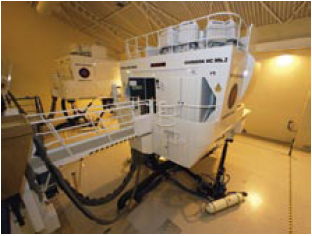
The Medium Support Helicopter Training project includes the provision of a number of flight simulators based at RAF Benson. Pictured above is one of the Chinook simulators.
|
The project is delivering its intended service to users, overcoming some early problems
27 The Medium Support Helicopter Aircrew Training contract, signed in October 1997, was one of the first operational Ministry of Defence PFI projects. The project has been fully operational since March 2001 and is still recognised as a leading facility of its type. It is used not only by RAF aircrew but also by aircrew from allies including the Dutch, Australian and Singaporean air forces. The contract could run for 40 years but the Department has the right to break, without compensation to the contractor, at the 20 year point in 2017.
28 The Medium Support Helicopter Aircrew Training Facility project experienced some problems with the delivery of the PFI project. Overall the project was delivered on time, but individual delivery milestones were missed, due to the contractor experiencing difficulties in delivering the agreed visual system. In line with the contract the Department charged the PFI delivery company liquidated damages of £2.98 million on the missed milestones. These costs were passed down to the company's subcontractor.
29 The difficulties meant that an interim visual system had to be put in place with limited capability to reproduce special effects. This impacted on the realism of the simulator and as a result user satisfaction was reduced. The early problems with the Medium Support Helicopter Aircrew Training Facility project were subsequently fully overcome; however, it involved a lot of effort to manage the expectations of the users during this difficult period.
Overall usage of the facility is not as high as expected
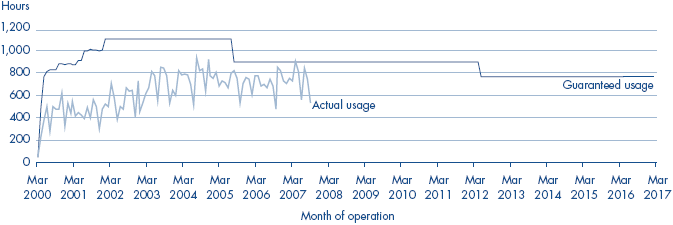
30 A level of usage, equivalent to 80 per cent of the facility's capacity, is guaranteed to the contractor across the first 20 years of the contract. Actual usage of the facility has been, and is currently, lower than the level that is guaranteed to the contractor. Overall usage over the in-service phase to December 2007 has been 64 per cent of the level guaranteed in the contract, with 34,000 unused hours. The Department has contracted and therefore paid for capacity that it has not subsequently needed. Expected usage included Chinook Mk3 training, but that aircraft has still to be introduced to service. However usage is increasing; in 2007 usage was 84 per cent of the guaranteed level and in the later stages of the contract it may exceed the guaranteed level. This would result in the Department having to buy additional hours' usage at a cost of at least £250 per hour. In such cases, the Department will need to ensure that usage of the service is optimised in the remaining period of the contract and that the project team is working actively with the contractor to ensure that this happens.
31 The Department originally anticipated that the facility would be in use at least at the guaranteed level for much of the time. Usage of the facility as a whole has steadily increased throughout the contract term. However to date it has, generally, been lower than the guaranteed level. As a result of this, the Department may have retained a greater level of risk on the usage of the facility than it expected. Whilst the Department may sometimes require spare capacity to cope with surges in demand, the Department has contracted for capacity that it has not subsequently needed. Overall value for money will be dependent on ensuring that the usage of the facility is optimised; in the longer term there may be additional cost to the Department if the usage goes above the guaranteed level. If a conventional solution had been used it is likely that the same number of simulators would have been provided and therefore its value for money would have been similarly affected by lower than expected utilisation.
32 It is difficult to identify a single cause for the lower than expected usage. Factors that may have caused a discrepancy between the expected and actual usage of the facility may include:
■ the Chinook Mk3 aircraft has not been introduced into service;
■ changes to the timing and numbers of Chinook, Puma and Merlin helicopters procured by the Department; and
■ higher than expected operational deployment during the contract period, which means that aircrew are not available for training.
The structure of the contract is working well but there are ongoing risks that need careful management
33 In training programmes such as the Medium Support Helicopter Aircrew Training Facility, the quality and relevance of the training to users depends significantly on whether the training environment is faithful to the aircraft or other platform that is being simulated. The Department is responsible for funding this type of modification and, whilst there has been investment in the facility, it has not always been possible to match updates to the aircraft on a like-for-like basis. This is an issue on the Chinook simulator, which is now divergent from the actual machine, particularly on the version of the Chinook used by Special Forces.
34 A dedicated, senior user representative is based on site and is working with the project team who manage the contract, the private sector contractor and the user community in order to promote use of the facility. The project team monitor user satisfaction formally as part of its performance monitoring, via the project's own balanced scorecard.
35 The contractor has also made some investment in the facility, from which the Department and other third party customers should benefit. A contractual value for money review due in 2008 will provide an opportunity to discuss the long term strategy for the facility, particularly in view of the potential no compensation break-point due in 2017.
23 | Usage of the facility has been below the expected level and the level at which payment to the contractor is guaranteed |
Source: Ministry of Defence | |