CASE STUDY 4
CASE STUDY 4 | ||||||||||||||||||||||
Armoured Vehicle Training Service (AVTS)
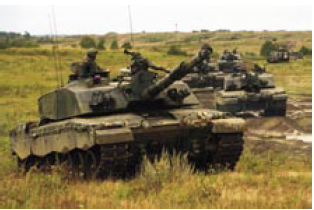
The Armoured Vehicle Training Service was designed to provide a balance of live and synthetic training for a number of Armoured Fighting Vehicles including the Challenger II tank pictured above.
|
The project was ambitious and had the potential to use PFI to improve value for money
36 The Armoured Vehicle Training Service was a procurement project that was intended to deliver a PFI contract to train the army's armoured vehicle crews. The proposed service included the provision of instructors, training services, training equipment and buildings, design of the course syllabus and development of training devices. This project had a total contract value of over £1 billion and the training would have taken place across multiple sites and trained Army personnel on a variety o f armoured vehicles, including the Challenger II Main Battle tank. Similarly to the Medium Support Helicopter Aircrew Training Facility project, the rationale was to use simulation and other measures to produce efficiencies. These efficiencies would arise out of reducing the number of miles that vehicles were used in the field for basic training and out of reducing the amount of live firings.
The deal was cancelled in June 2005 and the Department made payments to the bidders of £10.6m. An additional £5m had been spent on the Department's advisers
37 The OJEU was issued in October 1999 and the Outline Business Case was approved in December 2000. Three consortia were bidding for the project and in July 2004 the Department appointed an intended preferred bidder. After further negotiation the parties were unable to reach an acceptable agreement resulting in the announcement in June 2005 that the PFI project would not go ahead.
38 The cost of the abandoned PFI project included £5 million spent by the Department on advisers in the bid evaluation phase, though the spend on advisers prior to 2000 in the early phase of the procurement is unknown as records were not retained. The Department's own internal cost of resourcing this major procurement over the six years of the project was not recorded, as this was not a requirement. In addition, the bidders are likely to have incurred substantial costs, both in terms of direct costs and the opportunity cost of not being able to use their bid resources on other projects. The experience of the cancellation may also have affected market confidence with bidders not willing to bid on other projects.
39 The Department's procurement team were redeployed with many of them working on an alternative to Armoured Vehicle Training Service through a conventional procurement programme. The project (re-named ECATS) has delivered capability in the form of the Live Fire Crew Training System (LFCTS) for Challenger II gunnery (a removable barrel insert with a smaller bore). The Department decided to secure the intellectual property rights produced by the bidders for Armoured Vehicle Training Service for possible use in this new programme.
40 Following the cancellation of the deal a total of £10.6 million was paid to bidders by the Department. Of this £7.7 million was paid to secure intellectual property rights (IPR) for material produced during the procurement. The IPR has not been utilised to date, although the Department is confident that it will add value to the ECATS programme in due course. In addition to the IPRs, a sum of £2.9 million was paid to one of the bidders as an ex-gratia payment in full and final settlement of the cancelled project.
The procurement was not well managed
41 The Department has identified lack of procurement and project management skills as a major factor in the failure of the cancelled Armoured Vehicle Training deal. The Department's post project evaluation concluded that the project team was not adequately resourced, or sufficiently experienced in dealing with PFI procurements. The team was also not well supported, since it was based in a different physical location, Bovington, from the main Defence Procurement Agency (DPA) base at Abbey Wood. The project did not have a Senior Responsible Owner, though this was not a requirement at the time. Later on in the deal, a new experienced team was put in place. The appointment of the new team led to the reanalysis of the project and the decision to abandon the PFI strategy.
42 As a result of the problems identified the procurement process took a long time; requirements were not adequately specified and had to be developed as the team gained an understanding of the project. This was achieved by having a number of bidding rounds.
The intended transfer of risks was not supported by adequate management information, and additional information was not collected
43 In addition to the issue of defining the requirement the project team were driven by the desire to ensure that the asset would be off balance sheet to address the Department's affordability concerns. This meant that there had to be sufficient risk transfer to the private sector and one of the key risks was the amount of live resources (such as ammunition and hours spent in armoured vehicles) required by candidates to pass the various tests they would face during their training.
44 A key part of the deal structure was the transfer of course pass rate risk and this influenced the amount of live resources to be managed and used. However, historical data on live resource use and student pass and failure rates were neither reliable nor complete. The project team decided to proceed in the absence of this data; however they did not seek to collect the data during the course of the procurement. This led to fundamental misunderstandings between the public and private sector about the scale of the risk being transferred.
45 At the time when bidders were submitting their Best and Final Offers (BAFO), a new team, based in Abbey Wood, were put in place together with new legal advisers. Although the Ministry of Defence and its advisers had misgivings they decided to press ahead with the BAFO round to ensure that the project did not suffer any further slippage.
46 After the BAFO round there were still concerns and the Ministry of Defence decided to appoint a provisional preferred bidder for a risk reduction exercise. Further problems and concerns over the value for money led to the decision being made to abandon the PFI strategy and to seek a conventional procurement, which will provide improvements to existing capability over a number of years.