CASE STUDY 5
CASE STUDY 5 | ||||||||||||||||||||||
Main Building Redevelopment (MBR)
The refurbished Ministry of Defence Main Building as seen from the air.
|
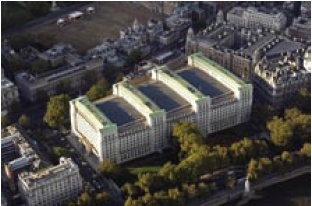
The existing building in Whitehall required improvements to the accommodation and working environment
47 The Department requires secure, modern and efficient working accommodation in central London from which to direct defence operations. The existing building in Whitehall required improvements to the accommodation and working environment. To this end the Department signed a PFI contract with Modus - a consortium comprised of Innisfree, Laing and Amey10 - in May 2000 to redevelop the Ministry of Defence Main Building. The redevelopment also enabled the Department to rationalise staff in London and dispose of five of its sites resulting in estimated savings of up to £18 million a year.
48 The contract covered the redevelopment of Main Building and limited refurbishment and provision of support to other buildings where staff would be accommodated during the redevelopment. It also included the provision to 2030 of maintenance and facilities management at Main Building and the Old War Office following completion of the redevelopment. The project was complicated by the need to decant 3,000 staff into other central London accommodation during refurbishment.
49 The contract allocated the majority of the risks associated with the project to the consortium, with only the risks relating to delivery of Department operational objectives and the information technology systems remaining with the Department.
The decision to pursue the PFI solution was based on the assessment of additional benefits that would flow from PFI
50 The Department estimated that the cost of the PFI deal would be similar to conventional procurement. The decision to pursue the PFI solution was based on the assessment of additional benefits that would flow from PFI. The Department considered these to be the following:
■ Greater price certainty.
■ Incentives to complete on time - under the contract, Modus would lose £1 million for each month of delay after the 30 November 2004 deadline for reoccupation. It would also have to meet the cost of maintaining alternative accommodation.
■ Incentives to deliver the service to the required standard - under the contract, Modus only receive the full annual fee once the accommodation has been provided to the specified standards, even if the Department chooses to use the accommodation. Furthermore, up to 20 per cent of Modus' facilities management charges are at risk if the standard of service provision is not satisfactory.
■ A single contract for the design, maintenance and operation of the building encouraging whole-life costing.
51 The Modus bid was selected as preferred bidder in January 1999 as its bid was £42 million lower than that from its competitor and it more closely matched the Department's output specification and commercial requirements.
The price of the deal increased during the preferred bidder stage
52 The deal was closed 16 months after Modus became preferred bidder. During this period the price increased by £99 million (at 2000 price levels). This was due to interest rate increases, identification of additional capital expenditure and other movements in the financial markets.
The project was the subject of an NAO value for money report
53 The Main Building project was the subject of an NAO value for money report (HC 748) in April 2002. The report concluded that:
■ the contract gives the Department what it set out to procure - specifically, it requires Modus to deliver the Department's physical requirements and it has the appropriate features of a PFI deal including risk transfer;
■ the costs under the contract will be similar to the forecast cost of conventional procurement but the balance was tipped in favour of PFI by other factors;
■ the procurement was effective - specifically, the deal was selected only after a wide range of options had been considered and the cost of the deal increased mainly due to survey work and increased financing cost including increased interest rates, the risk of which normally rests with the public sector until contract signature; and
■ the management of the contract has been good - specifically, the Department has conducted partnering workshops, adopted a joint mission statement with Modus, maintained the continuity of well-trained, appropriately skilled staff and adopted appropriate change procedures.
The refurbishment was completed ahead of schedule
54 Since the NAO report was published the refurbishment was completed ahead of schedule and staff were moved back. Generally the project has been a success with only minor issues arising. These issues have largely related to poor performance in the delivery of soft services. The problems were also exacerbated by changes in the contractor's management but since then the management team has been strengthened.
The Department is resurrecting its risk management procedures
55 Risk management had been particularly thorough during the procurement phase but had lapsed in its thoroughness during the in-service phase. The Department's contract management team was in the process of re-establishing its full risk management processes. In November 2006, Modus introduced a shared risk register to cover the generic risks shared by both parties. The Department were in the process of updating their risks into this register during the course of our study. We were told that the risk register will be formally reviewed by the Facilities Board that meets on a monthly basis.
There have been issues with the payment mechanism
56 Many PFI projects require the contractor to carry out performance monitoring. However in the case of the Main Building Redevelopment project, this task fell to the Department contract team. The annual cost of carrying out the service audits in 2002 was some £75,000 a year. Service delivery deductions between August 2000 and August 2006 totalled £221,000, an average of £37,000 per annum.
57 The contract's performance management mechanism generates low value financial deductions in respect of minor shortfalls in performance delivery; larger deductions would arise in respect of any part or aspect of the buildings or their services that are unavailable for use by the Ministry of Defence. As there have been no "unavailability deductions" levied to date and only relatively minor weaknesses in performance delivery, the penalties incurred to date have been small. The service audits have not addressed the minor shortfalls in performance.
58 The contract management team decided to suspend the service audits in September 2006. Both Modus and the Department state that they are determined to maintain and improve performance standards and are working together to introduce a more effective audit methodology. This had not been implemented at the time of our audit.
___________________________________________________________________________
10 Amey were subsequently bought out by other members of the consortium.