CASE STUDY 6
CASE STUDY 6 | ||||||||||||||||||||||
Defence Animal Centre (DAC)
Eighteen Dogs and eighteen horses paraded before they were marched off to their new home at the Defence Animal Centre at Melton Mowbray.
|
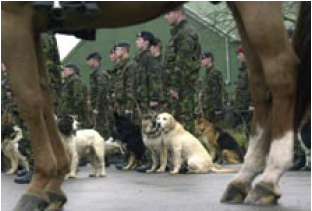
The Defence Animal Centre (DAC) is a mixed military and civilian agency responsible for training ceremonial horses and dogs for search and security duties
59 The Defence Animal Centre is a mixed military and civilian agency responsible for training ceremonial horses and dogs for search and security duties. It also trains service personnel in equitation, dog handling and animal welfare. Training of Military Working Animals and associated service personnel is Defence Animal Centre's core business and is undertaken by the Army and the Royal Air Force.
60 The Defence Animal Centre estate incorporates indoor and outdoor canine and equine training facilities, kennels and stabling, grazing land, forge facilities, a veterinary hospital, offices, messes, leisure facilities and single living accommodation. Until January 2002, the headquarters facilities and the living accommodation were wooden buildings constructed in 1936 and intended as temporary accommodation. By the early 1990's these facilities were in very poor repair requiring heavy maintenance expenditure. In 1995, the Department decided to explore the PFI option for private sector involvement in the delivery of accommodation and services to the Defence Animal Centre.
61 The project required a new headquarters facility comprising office, messing and single living accommodation, stores, motor transport garaging and leisure facilities to be constructed on Defence Animal Centre land. The vacated headquarters site was to be demolished for the private sector partner to sell for redevelopment. The services to be delivered covered all non-core activities except physical security duties which the Department would continue to provide. The Department would retain responsibility for the training of Ministry of Defence personnel and animals.
62 The competitive process started in late 1996 with a contract being signed in August 2000 with Realm Services (DAC) Ltd. However when the contract was signed it was considered to offer only marginal value for money. The deal would be considered too small for a PFI project today (as its capital value is less than £20 million). It is generally thought that the cost of procurement and setting up the deal structure outweighs any potential benefits to be gained from such projects.
The facilities were delivered 11 weeks late
63 Realm delivered the new facilities 11 weeks after the Scheduled Commissioning Date for which it paid a performance deduction of £29,000. Realm also took over responsibility for the existing facilities and equipment. However they did not agree with the Department the condition of those assets to set the base line to determine whether the asset was fit for purpose and deemed available in the future.
Aspects of the contract are vague and the payment mechanism is ineffective at transferring risk to the contractor
64 With respect to the support services the contract specifications were loosely drafted and open to interpretation. For example, the cleaning output specifications for furniture and fittings are that they are to be free from dirt or dust which in the reasonable opinion of the monitor has been in place for an unacceptable period of time. The requirement is subjective and difficult to measure and the monitor is the contractor.
65 The contractor is responsible for measuring performance. It does this through generating a random sample of Support Service Events from around some 56,000 events. The random sample is 0.7 per cent of the total, which means that the contractor needs to check some 390 support service events on one day each month. As checks only have to be made once a month only a small number of performance indicators are tested. In addition, certain key aspects of the service are not subject to inspection in the monthly monitoring process whilst the relevance of others is questionable. For example, one measure is to ensure that the sanitary ware in the veterinary hospital X-ray viewing/developing room was regularly cleaned. There is no sanitary ware in that room and so the service is automatically deemed to have been delivered.
66 In addition to the service deductions there are penalties for when assets are not deemed available. To date availability deductions have totalled c£14k. However the penalties are small, for example if one of the Junior Ranks' Accommodation units failed to meet the availability criteria for a whole month, then Realm would face a deduction of only £88. More critically the penalty for not making the Riding School available is only c£800 per month. This is disproportionate to the cost of providing an alternative facility.
67 In practice the Department accepted the deficiencies of the Riding School and made use of the facilities. However, by using the facilities the Department loses its right to impose the penalties. Realm had made some attempt to repair the existing Indoor Riding School facilities but it had been deemed unsuitable and not fit for purpose by the British Equine Association. In the event the Department replaced the existing Indoor Riding School with a much larger one that meets modern training best practice and safety needs. The total cost of the new facility to the Department was £0.705 million.
Relationships have historically been poor and the contract weaknesses need to be addressed
68 At the Defence Animal Centre, there have been major changes in the staffing both on the Department and contractor side. Combined with the problems in determining the service levels this has contributed to relationships which have historically been poor. However the Department have made some progress by carrying out a post project evaluation of the project which was completed during the course of our study. The NAO agrees with the Department's conclusion that the contract needs to be renegotiated. If agreement cannot be reached the Department should consider the option of terminating the contract.