CASE STUDY 8
CASE STUDY 8 | ||||||||||||||||||||||
Tidworth Water & Sewerage
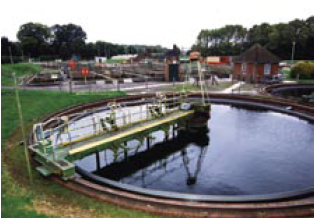
Views of the Tidworth Sewerage works.
|
The Department needed to transfer the service provision to the private sector
83 The Tidworth Water and Sewerage contract provides services to the Tidworth Garrison including civilian residents of the town. The system consisted of departmentally owned and operated water and sewage systems. By 1993, the system was unreliable and in poor repair. At this time the Department was losing crown immunity and the facilities would not have been legally compliant.
84 Prior to the initiation of the project, the Property Manager's technical consultants advised that capital works to the value of around £7 million would be required to make it compliant. This would be achieved by closing one of the two sewage treatment works, rebuilding the other and installing a pumping main to link the sites. At this stage a project team was established to consider all the options open. The scope was widened to include the sewage treatment works and also sewers, water abstraction, treatment, distribution and billing of non-MOD customers. This option was used as the Public Sector Comparator, retaining the facilities within MOD ownership. This was a live option.
Negotiations with the Preferred Bidder failed and the Department called on the reserve bidder
85 The project was advertised in May 1995. Wessex Water was selected as preferred bidder in July 1996. However, during the preferred bidder negotiations agreement could not be reached on the transfer of risk, particularly around the extent of contractor liabilities and potential payments to the contractor in the event of breach or termination. As a result, the Department terminated its negotiations with Wessex and brought in the reserve bidder, Thames Water. Agreement was reached with Thames in March 1998.
The Department retained some risks
86 It was agreed that the Department would retain risks for treating poly-aromatic hydrocarbons originating from the linings of the old MOD water mains. EU legislation was subsequently changed and the particular substance found at Tidworth was removed from the standard following the evidence that there were no health effects at the levels found in drinking water. Therefore the Department incurred no additional costs with respect to this risk.
87 Whilst Thames Water were willing to accept risks found in their systems elsewhere, they were unwilling to accept risks arising from MOD contamination which they could not evaluate. The project team were unaware that there had historically been inappropriate use of the sewers - including bullets dating from World War II - being placed in drains. As the extent of the contamination was unknown, the risk premium that Thames Water would have charged the Department would not have been value for money. The Department was also best placed to mitigate this risk and the Department's Explosive Ordnance Disposal teams are called out whenever incidents arise. The Department can also stop any future misuse by educating personnel and ensuring that appropriate disciplinary measures are in place. Thames Water accepted the risk of all other forms of contamination.
The contract has been a success but a new facility was not delivered
88 The service has been a success with high levels of performance by the contractor. Both sides attribute this level of performance to the contractor's desire to maintain its corporate reputation and the good relationships that have been established. The relationship has also been helped by the fact that there has been staff continuity on both sides.
89 The negotiated contract was in the form of an output specification; however, unlike the public sector comparator, there was no explicit requirement that the contractor should combine the sewage treatment works and build a new facility. Instead Thames Water uses risk processes and a condition based approach to repair and maintain the existing assets that provide the services.
90 Despite the lack of a new facility, the water output has increased and Thames Water have been able to export water to neighbouring areas, generating third party revenue which has been shared with the Department. However, leakage rates remain high at between 40 - 60 per cent. The contract does not specify leakage targets at all since the water regulator, Ofwat, sets leakage targets11 for the water industry, and this now applies to Tidworth. If at the end of the Thames Water contract leakage levels are above those permitted this may be a consideration for bidders when the current contract comes to an end and is re-let. The assets will not be transferred back to the Ministry of Defence as under Ofwat rules the facilities can only be transferred to another statutory undertaker, who will then bill the Department for the service.
91 The performance regime is not an important driver of good service delivery by the contractor. This is because the penalties are not a strong incentive as they are of relatively small value. For example foul sewage flooding to the indoors of premises would cause ten performance points to be awarded, which would incur a penalty of £150. However, performance failures have been rare and deductions through the life of the contract have totalled only approximately £200. This is because the contractor's corporate reputation and good relationship with the Department have driven performance and not the potential imposition of contractual penalties.
The project may benefit from greater use of risk management processes
92 There are risks to the project that will have to be managed and mitigated against. These include:
■ Thames Water are looking at selling their Services Division. This would include the Tidworth Water and Sewerage contract. This, together with any change in staffing may affect future service delivery; and
■ There are some difficulties over the interfaces with the project and Ministry of Defence properties in the Tidworth area. When Defence Estates Housing Directorate let a contract covering Service Families accommodation in 2006 there were minor omissions in the contract documentation. This potentially meant that there was no contractual cover to part of the water piping for any necessary repairs that arise. To date this has not been a practical problem as Thames Water have been willing to carry out any repairs necessary.
93 Although Thames Water utilise a risk-based approach to operational management of the contract, the Department manages its own risks informally. Use is not currently made of risk registers and mitigation plans. Formal risk procedures may increase the Department's ability to identify and mitigate risks effectively.
___________________________________________________________________________
11 Leakage targets apply to the company as a whole, and not to specific locations. It is up to the contractor to decide how best to allocate its resources to meet those targets.