New public procurement regulations require a radical change in the way PFI deals are tendered
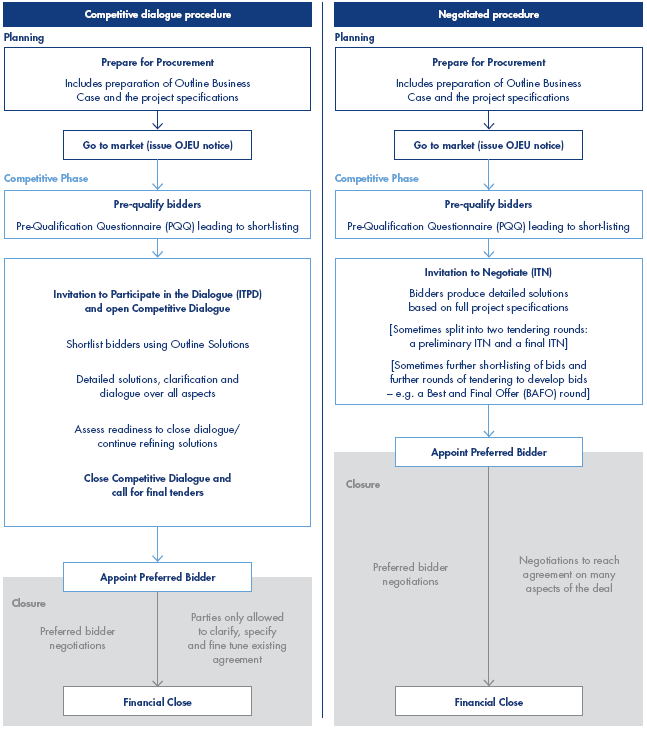
1.5 The procurement of goods and services by public authorities in the UK is governed by European Union Directives, designed to promote and encourage transparent and fair competition between contractors in EU member states. Changes to these Directives have been implemented in UK law from 31 January 2006. Prominent among the changes is the new procurement procedure of Competitive Dialogue for complex projects, such as PFI deals (Figure 3).
1.6 One of the main features of the new procedure is that there is less scope to make changes to a project after a preferred bidder has been selected. Although there is flexibility within Competitive Dialogue for bidders and the authority to discuss how the output specification will be met, once the competitive phase has closed, bidders can only be requested to "fine tune, specify and clarify their bids". Any change to the preferred bid must not substantially modify what had been agreed and must not distort the outcome of the competition, though the definitions of the scope or other changes that will be allowed during the preferred bidder period have yet to be tested in practice.
1.7 From 31 January 2006, the Competitive Dialogue process codifies in law what should have been good practice under the previous procurement procedure, for example:
■ up-front planning with a clearly defined scope and a well-developed draft output specification before going to the market;
■ not choosing a preferred bidder until all bidders' offers have been fully probed under competitive conditions.
1.8 The introduction of Competitive Dialogue should have benefits in terms of encouraging better procurement practice and strengthening the competitive element of the PFI procurement process, reducing the scope to make significant changes to the deal once the competition has closed. This should reduce time taken and costs in the preferred bidder stage, but there are risks as well. In particular, there is a risk that the need to negotiate more of the deal with a greater number of bidders prior to preferred bidder selection will increase overall tendering costs for both the public and private sectors, and that this, in turn, will weaken bidder interest.
3 | The new and old procurement processes (illustrative) |
| |
Source: National Audit Office | |