There is evidence that PFI projects are receiving fewer developed bids than previously
2.1 Strong competition is essential if PFI deals are to achieve the optimal mix of price, quality and risk transfer. We therefore looked at how effective the bidding process during tendering has been in generating and maintaining competitive tension, focusing especially on the point in the process where bidders are invited to substantially develop their bids (the "invitation to negotiate" or ITN stage). It is important that the public sector has strong competing bids to consider at this point.
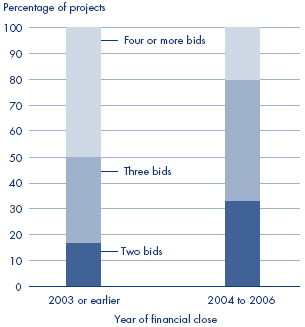
2.2 We compared projects that closed at different points in time to explore trends in the number of developed bids submitted. Figure 4 shows that 85 per cent of PFI projects included in our sample that closed prior to 2004 attracted three or more developed bids. However, the figure for a comparable number of more recently tendered projects has reduced to 67 per cent. One third of the projects included in our census, closing between April 2004 and May 2006 (with no differences between sectors), attracted only two bidders at the point they were requested to submit detailed bids.11
2.3 In the schools sector, there is a new delivery programme known as "Building Schools for the Future". Early indications from Partnerships for Schools, the dedicated body set up to oversee the programme, suggest that competition has been relatively strong so far. Fifteen out of the 17 schemes that have reached ITN (or its equivalent under the Competitive Dialogue rules) attracted three or more developed bids at that stage.
4 | The proportion of projects attracting only two viable bids has increased in recent years |
| |
Source: National Audit Office surveys 2006 | |
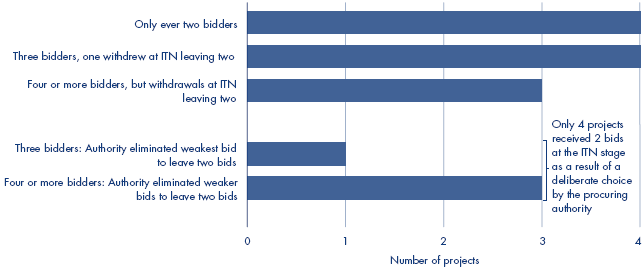
2.4 In the majority of the projects receiving two developed bids that closed between April 2004 and May 2006, this was because of insufficient bidder interest in the project. Either there were only two bidders from much earlier in the tendering process, or existing bidders withdrew from the competition. It was comparatively rare for these procuring authorities to choose to eliminate weaker bids: the choice was effectively out of their hands (Figure 5). Procuring authorities which received only two viable bids at ITN argued that the impact on value for money was limited. They considered that the two bids left on the table were of high quality, and that two bids still allowed for competitive tension (in contrast with single-bidder situations).
2.5 It may become more common under competitive dialogue for procuring authorities to choose to go down to two bidders at an earlier stage in the process than has been usual up to now because of the need to reach a greater level of agreement prior to the selection of the preferred bidder. Nevertheless, the absence of a third bid removes the possibility of having a 'second opinion' benchmark on value for money. It also leaves the procuring authority vulnerable if one bidder subsequently pulls out.
5 | Most projects received two bids at ITN because of insufficient bidder interest (projects closing April 2004-May 2006) |
| |
Source: National Audit Office census 2006 | |
___________________________________________________________________
11 i.e. at the Invitation to Negotiate (ITN) stage.