Lengthy tendering periods and inadequate preparation of projects have put off some bidders
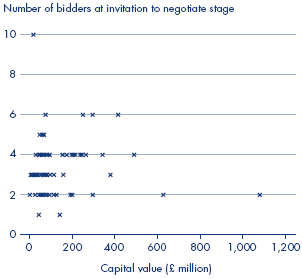
2.6 As Figure 6 overleaf indicates, the number of developed bids received by procuring authorities has been unrelated to the size of the projects being procured. Larger deals have been as likely to receive relatively few developed bids as smaller deals.12
2.7 Instead, our discussions with private sector contractors, advisers and others indicated that there were two principal reasons why bidders may have been more selective in developing detailed bids for PFI projects:
■ High bid costs and lengthy tendering periods, which reduced the number of projects for which contractors were prepared to bid in any particular year (Box A overleaf). It was common for contractors to set an annual budget for how much they were prepared to spend on bidding for PFI and they would not exceed this.
■ Greater international opportunities, which led to some companies reducing their exposure to the UK market.
|
6 |
For projects closing between 1995 and 2006 there has been no relationship between the size of a project and the number of viable bids received |
|
|
|
|
Source: National Audit Office surveys 2006 |
|
|
BOX A |
|
The views of the Business Services Association, a representative body of PFI contractors "In some ways capacity is limited because bidding companies now work to the assumption that procurement periods will typically be longer than planned for by Authorities… Delays are limiting the desire of companies to bid."13 |
2.8 In addition, there were four main reasons which contractors reported that led them to withdraw from competitions or to avoid particular projects altogether:
i) Perceptions of the level of skills and experience contained within public sector procurement teams
2.9 Contractors regularly assessed the level of skills and experience within public sector procurement teams to help reach a view on the viability of a project and the likelihood of delays. Just under one-third of procuring authorities reported that they had had insufficient resources or in-house expertise for part or all of the tendering process. This will have had an adverse impact on the competence of the public sector team as seen by potential bidders.
ii) Perceptions of the quality of preparation for particular projects
2.10 In the view of contractors, the adequacy of project preparation was very important in determining whether to bid, as evidenced by the quality of the project specifications and the overall tender documentation. Contractors thought there was scope to improve project preparation and also stressed to us the need for certainty about the affordability of projects.
iii) Inadequate planning of deal flow
2.11 In some cases, projects attracted fewer bids because of inadequate pre-OJEU up-front warning about the timing of projects being brought to the market or because of inadequate co-ordination of deal flow (Box B). In either case, the result was that contractors were not in a position to respond when deals came to the market. Some contractors also commented that even where the deal-flow was well-managed within sectors, there was little co-ordination between sectors.
|
BOX B |
|
Kirklees City Council - the importance of managing deal flow Kirklees City Council first brought its special schools PFI project to the market in march 2002, just before the end of that financial year. However, many other projects went to the market at the same time, and the Council only received two bids. Following consultation with the Department for Education and Skills, the Council decided to re-submit the project to the market in may 2002. This time it received seven bids, of which six were viable bids. |
iv) Geographical location
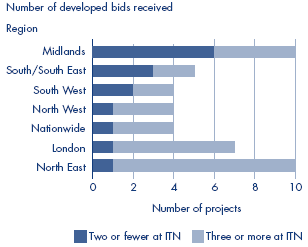
2.12 Figure 7 indicates that, with very few exceptions, projects that reached financial close in the two years up to May 2006 and which were tendered in London, the North West and North East had three or more bidders at the invitation to negotiate (ITN) stage. More than half the projects tendered elsewhere in England during that period were down to two bidders at ITN.14
|
7 |
The number of developed bids received for projects which closed between April 2004 and May 2006 has been partly influenced by geographical location |
|
|
|
|
Source: National Audit Office census 2006 |
|
2.13 Some PFI advisers and contractor consortia pointed to impracticalities in bidding in certain parts of the country, due to the small number of regionally based sub-contractors who were acceptable to bidders and capable of taking on the work. In addition, some contractors felt that they would be at a competitive disadvantage in a region in which they had no existing links with sub-contractors.
___________________________________________________________________
12 See Appendix 4 for the statistical basis of this statement.
13 Interview with Business Services Association, 28 February 2006.
14 However statistical analysis has not confirmed a correlation between geographical location and the number of developed bids received, possibly because of the small number of cases involved. See Appendix 4 for further details.