Professional advice usually cost more than planned and greater public sector experience would have led to savings
3.23 The cost of professional advice on PFI projects that closed between April 2004 and May 2006 was on average 75 per cent higher than budgeted for by the Authority at the outset of the project. Many Authorities considered that their original estimates of adviser costs had been unrealistic and our discussions with advisers confirmed this. Reasons given by Authorities and advisers for cost under-estimates included:
■ optimistic assumptions about the project timetable;
■ inadequate analysis of what advice will be needed when; and
■ lack of forethought about the division of responsibility between the Authority's procurement team and professional advisers.
3.24 A significant cause of higher than expected advisory costs for Authorities was the length of time it takes to close a deal after selecting a preferred bidder, with most Authorities identifying this as the point at which costs begin to escalate. This situation was exacerbated by the difficulties of agreeing fixed or capped fee arrangements with advisers because of the uncertainties surrounding this period. The average cost of advisers for a PFI project which closed between April 2004 and May 2006 was £3 million, or approximately 2.6 per cent of the projects' capital value, though this proportion varied by sector, Figure 13. The percentages shown exclude any costs borne centrally, for example, in producing standardised building designs.
13 | Average costs of advisers as a percentage of the capital value of a deal |
| |
Source: National Audit Office census, 2006 | |
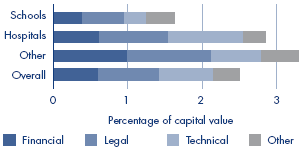
3.25 In the health sector, the only sector for which data are available over time, we found that the costs of advisers as a percentage of capital value had gone down slightly when compared with a sample of hospitals projects that closed between 1997 and 200020. It is likely that the introduction of the standard form contract was partly responsible for this.
3.26 Our statistical analysis, Appendix 4, shows that variations in the cost of advisers across projects were determined mainly by the size of the project and to some extent by the sector allowing for size. The tendency was for adviser costs for schools projects to be lower per pound of capital cost than for PFI hospitals and both sector adviser costs were lower than for "other" PFI projects. This tendency is likely to be related to the intrinsic complexity of the type of PFI project services. Overall, some three quarters of adviser costs were accounted for by capital cost variation and sectoral differences. In addition, several advisers we spoke to told us that Authorities with experience of tendering PFI deals were using them far more cost effectively than those without experience. In practice, this meant going to advisers with a better idea of what they wanted (Box G overleaf). The case of Leeds City Council illustrates the importance of experience in affecting tendering times and budgets (Case Example 4 overleaf).
CASE EXAMPLE 4 |
Leeds City Council - the advantages of internal expertise and experience Leeds City Council established a dedicated PPP unit in 1999, responsible for taking forward all of its infrastructure projects. many of these have been privately financed, including schools, social housing, leisure and street lighting projects, with waste and highway maintenance projects currently being considered. In total, the Council's PPP unit has managed the tendering of deals worth £800 million and projected to rise to £1 billion within the next two years. The PPP unit has worked closely with client departments within the Council in order to take forward this investment programme. For each project, sector-specific expertise has been provided by an appointed project director, responsible for defining the scope of the project and liaising with stakeholders. The role of the unit has then been to supply the necessary procurement and commercial expertise to take the project forward, as well as to provide an internal challenge function. The first deal signed by Leeds City Council ran into a number of problems during the procurement, reflected in a 15 month preferred bidder period and overspends on advisers. However, the Council's PPP unit learnt from that experience. The last four deals signed, which included two relatively complex multi-site schools projects, were all tendered inside 18 months, with preferred bidder negotiations taking 4-5 months and advisers' costs coming within budgets. According to the Director of the unit, the build-up of experience has been fundamental to this success, enabling: ■ a better understanding of when and how to use external advisers; ■ a better understanding of how to define the project specifications, with far less need for change later on in the tendering process; ■ greater commercial awareness and more focused negotiations with the private sector. |
BOX G |
A leading legal adviser on PFI projects "Some Authorities dump everything on the external lawyers where in-house lawyers would be better and cheaper. Others only use external lawyers when they absolutely have to and this is not always best either: documentation comes too late and has to be re-drafted and changed. The big Authorities, on their 3rd/4th/5th projects are noticeably different: they understand the process and when to involve advisers, and this undoubtedly leads to better vfm. There needs to be more support for authorities lacking that experience." |
___________________________________________________________________
20 Hospital projects that closed between 2004 and 2006 spent three per cent of capital value on advisers. The comparable figure for hospital projects that closed between 1997 and 2000 was 3.3 per cent.