Implications of the department's plans to vacate buildings
2.18 In April 2008 the Department estimated it would make savings of £250 million through the Estates Consolidation Programme by vacating properties from the STEPS and non-STEPS estate. It estimated that the Programme would cost £99 million, including the cost of closing buildings (15 per cent) and reconfiguring buildings (85 per cent). In early 2009 the Department reduced the funding available for the Programme. In addition, the Department has a policy of avoiding compulsory redundancies as far as is reasonably practical. Because of the cost of compulsory redundancies, and the funding the Department has available, in some areas it has taken longer than planned to work through the implications of buildings closures. In some cases the Department is only partially vacating buildings until staff redeployment or redundancy can be managed. By early 2009 the estimated savings had fallen by £20 million to £230 million as a result of these issues.
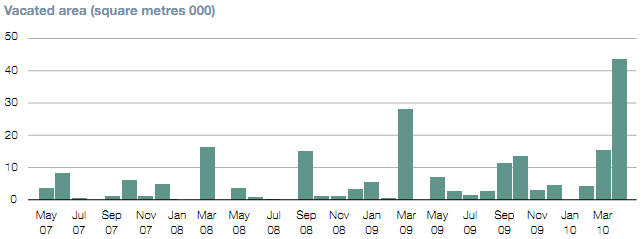
2.19 The Department's plans to vacate buildings have implications for Mapeley. The Department included Mapeley in its regional consultations to select individual buildings to vacate, but only provided full details of its plans towards the end of 2008. In January 2009 Mapeley approached the Department with concerns about financial pressures resulting from the programme in the current economic climate, particularly as planned vacations peak in March or April each year to maximise savings in the financial year (Figure 9). This puts Mapeley under pressure to find tenants for large amounts of space at the same time. Mapeley informed the Department that in the economic slowdown it is harder to re-let property and particularly difficult to re-let partially vacated properties or renew partial leases.
Figure 9 |
|
Source: National Audit Office analysis of Departmental data |
2.20 The Department should not make any concessions to Mapeley without corresponding benefit, however it may be able to ease the pressure on Mapeley by:
• Committing to buildings: Mapeley proposed identifying several buildings that the Department would retain beyond the life of the contract, allowing it to undertake deals that increase the buildings' value. It offered to share payments with the Department, or invest in improving the facilities. The Department did not accept this proposal as it did not consider the range of likely benefits was sufficient.
• Working with other bodies: the Department cannot sublet property under the contract, but can allow other central government bodies to occupy space. In February 2009 the Department had 40 minor occupiers in 80 STEPS buildings, occupying 86,000 square metres (seven per cent). There are opportunities for the Department and Mapeley to work more closely with other organisations to fill vacated space. The Department considers space vacated in regional areas is unlikely to meet the needs of central government departments, but may meet local government requirements. The Department can only accept central government bodies as minor occupiers, and it is time-consuming to make the legal arrangements to sublet to other bodies although there are examples where this has happened. HM Treasury's Operational Efficiency Programme reported in early 2009 on opportunities to use Government estate more efficiently, and recommended creation of a body to manage use of estate across the whole public sector.12
2.21 The Department's Estates Consolidation Programme covers planned vacations of properties up to 2012 but there remains significant potential for savings from further vacations to the end of the contract in 2021. The Department achieved £52 million in savings by the end of 2008-09. We estimate that it will save a further £281 million by 2020-21 on buildings already vacated by the end of 2008-09, and that it could save a further £295 million over the same period if it achieves its planned vacations under the Programme. If it fully uses all remaining allowances as they become available from 2012-13, it could save an additional £269 million. In total, it now has the opportunity to save around £897 million over the life of the contract, compared with the £1.1-1.2 billion available at contract inception.
2.22 To make the most of these opportunities the Department should have an over-arching estates strategy. Its current estate plans are operational rather than strategic, and negotiations with Mapeley tend to be building-by-building. In comparison, the Department for Work and Pensions has separate estates strategy and operations functions, which it considers essential for managing the PRIME contract. This enables strong governance and engagement by its Board. The Department now needs to start identifying buildings for future vacation. At present it has no plans for vacations beyond 2010-11. In 2011-12 it will accrue a further 44,000 square metres of allowances in addition to any allowances remaining unused at the end of 2010-11. Given budgetary restrictions and ongoing negotiations with Mapeley over compensation payable for its use of further core allowance, the Department may not be able to make full use of the vacation allowances available to it by the end of 2010-11.
________________________________________________________________________________
12 HM Treasury launched the Operational Efficiency programme in 2008 to review five areas of spending including property and estate costs. It reported the results in Budget 2009.