Part 1 The Treasury competition was a success
1.1 The Government Offices Great George Street are an important part of the Government's freehold estate. These offices occupy a prominent location on the corner of Parliament Street and Parliament Square and overlook St. James's Park to the west. They were built between 1898 and 1917 and there has been little subsequent modification or modernisation.
1.2 The internal configuration of the Treasury building, which mainly comprises cellular offices located off long corridors with very little open plan space, added to the long term maintenance requirements of the 100 year old building, led to the conclusion that it needed to be refurbished. Refurbishment would address the long-term maintenance problems and, by improving the internal layout of the building, provide modern, flexible and efficient office space.
1.3 The Treasury undertook a competitive procurement process to select a private sector partner to refurbish the building and then service and maintain it. In September 1996, Exchequer Partnership (Figure 1) was selected as the preferred bidder for the project. Following the 1997 General Election, negotiations between the Treasury and Exchequer Partnership were terminated. The new Government decided it was inappropriate to go ahead with this major project at a time when all departments were undertaking comprehensive spending reviews.
1 |
| Structure 1 of the Project Company |
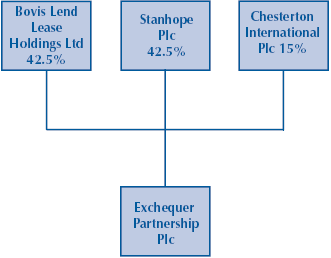
Source: National Audit Office |
1.4 Following the decision to terminate negotiations, the Treasury reviewed the project to assess the extent of work required and the priority of the project in relation to other demands on expenditure. The review confirmed that, after many years of only undertaking essential maintenance, the building was in need of a major refurbishment if it was to become a flexible and efficient office suitable for the future needs of the Treasury. Ministers agreed to go ahead with the project and negotiations between the Treasury and Exchequer Partnership were resumed in October 1998. A contract for the refurbishment and subsequent management of the building was signed by the Treasury and Exchequer Partnership in May 2000.
1.5 As Exchequer Partnership had made its previous bid in a competitive situation the Treasury decided that, on balance, it was appropriate to resume negotiations with Exchequer Partnership rather than hold a second competition. The Treasury and its advisers, however, wanted to introduce competition into the procurement. They considered that the funding of the project was one area where it would be beneficial to the project itself and to the development of the PFI generally, to hold a separate competition. The Treasury, therefore, re-opened negotiations with Exchequer Partnership on the condition that a competition would be held to obtain the financing for the project. It was thought appropriate that the risk of obtaining project funding should remain with Exchequer Partnership, which would also be responsible for running the funding competition.
1.6 This part of the report describes the objectives of the funding competition, how the process was managed and the financing that was put in place as a result of the competition. It shows that:
a The Treasury set clear objectives. There were good reasons for using a funding competition and potential benefits for the Treasury building project and the PFI in a wider context were identified.
b The funding competition was well managed. By agreeing early on to undertake a funding competition as part of a renegotiated deal, all parties had ample time to define their roles and structure the competition in a way that would optimise the likelihood of a successful outcome. Key to the good management of the competition was the strong Treasury project team, that included the Treasury Taskforce, and the appointment of experienced and appropriately qualified advisers.
c Funding was obtained on competitive terms and the financiers accepted the newly standardised contract terms.