The financial difficulties were caused by lower than expected visitor numbers
1.35 The main reason for the museum's operating deficits since its opening was the failure to achieve the expected levels of ticket revenue. In RAI's business plan projections in August 1993, ticket revenues were expected to be £3.4 million, rising to £3.9 million by 1999. Actual revenues were only £1.4 million in 1998, falling to £800,000 by 1999.
1.36 Failure to achieve the planned levels of revenue from ticket sales was due to much lower than expected visitor numbers. In May 1992 Schroders had assumed almost 1.3 million visitors when assessing the financial viability of the proposed museum. This figure for visitor numbers was based on earlier projections prepared in 1991 by PA Consulting and MORI. Based on these figures and assumptions about income from other sources such as sponsorship, special functions, museum services, and car parking fees, Schroders had forecast a net cash flow, after allowing for maintenance and debt servicing costs, of £2.8 million in the first year of operation, rising to £4.3 million by 2005. This gave a rate of return to investors on the original investment required to fund the construction and fitting out of the museum of 25 per cent over 25 years.
9 |
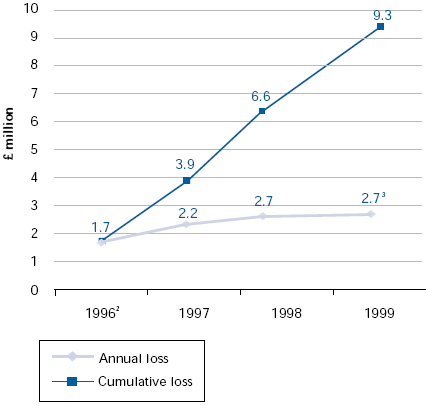
| RAI's losses' | |
|
| RAI incurred losses from the museum's opening and continued to do so.
| |
|
| Notes: | 1. Figures are for RAI's operating losses after interest. 2. 1996's loss was incurred from April to December 1996. 3. Forecast loss. The actual loss for 1999 was £5.5 million, resulting in total cumulative losses of over £12 million, after a large, one-off increase in depreciation to reflect a reduction in the value of RAI's fixed assets. |
|
| Source: Royal Armouries (December 1998) | |
1.37 Schroders also tested the impact on the investor's rate of return of visitor numbers in the range 750,000 to 1,500,000. They concluded that, if visitor levels were as low as 750,000, the project would still achieve a rate of return of 14 per cent. Schroders did not examine the impact of visitor levels below this figure. On the basis of this advice, the Department and the Armouries concluded that private sector operation of the museum was a viable proposition.
1.38 This high level of visitor numbers was generally confirmed by other studies. The August 1992 MORI study commissioned by the Department estimated that, based on a sample of 1,500 people across the country, the new museum would receive almost one million visits a year. The September 1992 study by Grant Leisure forecast 1.1 million visits a year on opening, rising to 1.3 million by 2000 and increasing thereafter.
1.39 RAI's own estimates of visitor numbers were lower than those produced by MORI and Grant Leisure for the Department, and were considered conservative by RAI (paragraph 1.28). The base case in RAI's August 1993 business plan had assumed that the museum would achieve a level of 900,000 visits in its first full year of operation. In October 1993 RAI revised its estimates downwards to reflect independent analyses commissioned by the two firms which were, at that time, competing to join RAI as the museum operator. Based on these analyses, RAI estimated that the museum would receive about 760,000 visits a year. For the museum to break even, it would need 550,000 visits a year. Independent research commissioned by RAI in 1995 from MEW confirmed that visitor numbers were likely to exceed this break-even point.
1.40 The only other private sector company to express an interest in the project, the Tussauds Group, who had a great deal of experience in running a major tourist attraction, withdrew their interest in June 1993 as, amongst other things, they considered that the forecast of visitor numbers prepared in 1992 for the Armouries and the Department was very optimistic and could not be realised, and their own forecasts were a great deal lower.
1.41 From the start of operations, however, visits to the museum have been considerably below the levels forecast by the Department's and Armouries' consultants, and by RAI (Figure 2). The break-even level of visitor numbers identified by RAI has not been reached in any year. The level of visits to the museum was around 63 per cent of the break-even level in the first full year of operation, and had fallen to 35 per cent by 1999. The shortfall is due to a number of factors including the lack of passing trade due to the delay in the development of the Clarence Dock area and to national stagnation or decline in museum visits.