The Department recommended that the Armouries accept a late proposal from RAI
1.85 RAI proposed a further option to the Department in late June 1999 (Option 7) for which it had obtained the support of the Bank of Scotland. Under this option RAI remained in place, though with reduced staff numbers, and retained the profitable corporate entertainment and car parking activities, and catering. The Armouries would take over responsibility for the remaining core museum functions, which it would support with additional grant-in-aid from the Department. Provided this option was adopted, the Bank was prepared to continue supporting RAI with further working capital and any net profit from RAI's future operations would flow to the Bank to repay the outstanding debt. In addition, all the financial proceeds due to the Armouries and RAI under the 1993 agreement with the British Waterways Board would go to RAI, to offset its existing debt.
1.86 The Department had a number of reasons for recommending this option to the Armouries. Firstly, it considered that this was the only option which was certain to meet its objective of keeping the museum fully open as RAI had told it that this option had the full support of the Bank of Scotland, RAI's principal lender. The Department considered that, if it supported the alternative option of the Armouries taking over all RAI's operational responsibilities (Option 6), RAI would go into receivership, leading to the likely closure of the museum, with the loss of control and uncertainty of outcome that this would entail (paragraphs 1.67 to 1.69). Option 6 could not therefore be achieved without the agreement of RAI or the Bank, and RAI did not agree.
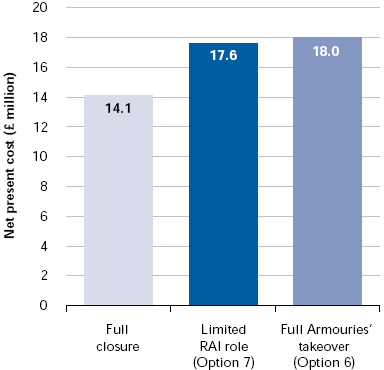
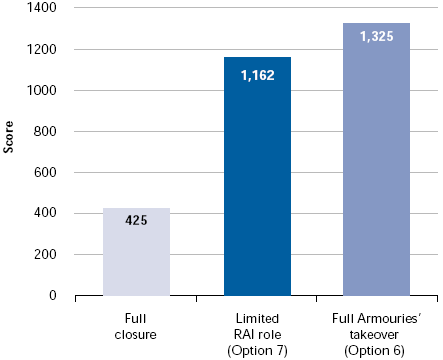
1.87 Secondly, the Department considered that the new option (Option 7) offered better value for money. It estimated that the option was marginally cheaper than the Armouries' preferred option, while offering a similar level of non-financial benefits (Figure 13). Under the Armouries' calculations, Option 6 had been less expensive than Option 7 (Figure 12) as, although the Armouries had assumed that it would need to pay rent to RAI in order to get speedy access to the museum, it had not quantified this payment since the payment had yet to be negotiated. The Department therefore assumed in its calculations that, under the Armouries' preferred option, the public sector would be asked to pay as rent the annual cost of £900,000 of servicing the existing RAI debt in full. For its part the Armouries considered that the maximum rent that it could afford to pay was likely to be insufficient to pay off the outstanding debt.
1.88 Lastly, the Bank formally confirmed that, if RAI's proposals were accepted, then the Bank would have no recourse to the Department or the Armouries to support RAI other than as set out under RAI's proposals. The Armouries would therefore not become responsible for RAI's outstanding debt of £20 million. The Department considered that the retention of this large liability in the private sector was in accordance with PFI principles and was a significant achievement.
1.89 The Department therefore formally recommended RAI's proposals to the Armouries in July 1999. It told the Armouries that this was the only option for which it would provide additional grant-in-aid.
…………………………………………………………………………………………………………………………………………………………………………………………………………………………………. | |||
13 |
| The Department's appraisal of options | |
|
| The Department considered that the option which involved a limited role for RAI (Option 7) offered the best value for money. | |
|
| Financial Evaluation1
| Non-financial Evaluation
|
|
| Note 1: The net present costs are based on the marginal costs of each option, discounted over 25 years. Option 6 includes payments to the Bank of Scotland in respect of outstanding debt. Source: Department for Culture, Media and Sport | |