The Armouries is now responsible for the loss-making parts of the museum operations
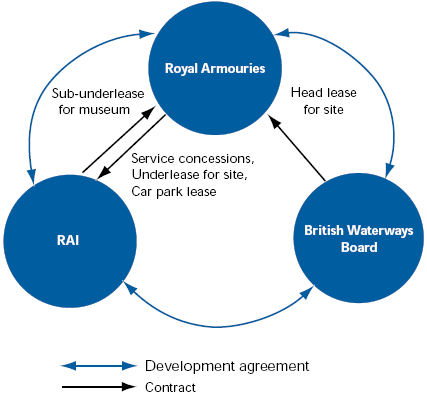
1.90 The Armouries and RAI reached an agreement on 30 July 1999 which restructured their relationship and provided a framework for completing the Clarence Dock development. Under the agreement, the Armouries has taken on responsibility for the core museum functions from RAI, and will fund these functions from museum revenues and additional grant from the Department (Figure 14). There have also been revisions to the contractual structure (Figure 15). As a result the Armouries now has sole control of the discharge of its statutory duties.
1.91 As the Armouries now is responsible for meeting all the museum's costs from any revenue it generates, a significant element of the demand risk associated with visitor numbers has been transferred to the public sector. Before taking on this risk the Armouries commissioned KPMG to review the museum's future potential operating performance, including future trends in visitor numbers. KPMG reported in June 1999 that the development of Clarence Dock, when complete, would attract people to the surrounding area, increasing the likelihood of admissions to the museum rising due to passing trade but that the resulting increase in visitor numbers would be at most ten per cent. However, if the Armouries took certain other steps, visitor numbers could be increased to at most 300,000 a year.
1.92 Subsequently the Armouries and the Department have identified further measures which could help to increase visitor numbers further. The Department, as part of its access policy for the charging museums that it sponsors, has agreed to make further resources available to the Armouries to provide free access for children and the over-60's from April 2001 and to enable the museum to introduce a reduced charge of £1 for adults from September 2001.
1.93 For its part RAI has retained responsibility for the provision of corporate entertainment and catering for 40 years, and for car parking for 57 years. The revised agreement contains no details of the level of charges RAI will levy on visitors for these services, although it does require these charges to be approved annually by the Armouries. RAI will also operate, and retain the income from, a new exhibition hall, being constructed as part of the Clarence Dock redevelopment, for 57 years or until its bank debt is fully repaid, whichever is the earlier.
14 |
| Responsibilities of the parties from 1999 | ||
|
| The Royal Armouries took on virtually all responsibility for the new museum from July 1999. | ||
|
| Public Sector Responsibilities | Private Sector Responsibilities | Joint Responsibilities |
|
| Operational phase |
|
|
|
| ■ Continue to lease the site for the new museum for 999 years1 from existing owner, the British Waterways Board, and sub-let to the private sector for 60 years. Pay the agreed lease rental to the British Waterways Board | ■ Under the sub-lease, reimburse the Royal Armouries for the annual rent payable to the British Waterways Board | ■ Draw up an agreed operating specification for the services RAI is to provide |
|
| ■ Pay the rent due to RAI under the sub-sublease for the museum | ■ Sub-sub-let the museum to the Royal Armouries for 58 years on a full repair and insure lease, for the rent payable under RAI's own sub-lease with the Armouries |
|
|
| ■ Provide the major part of the collection for exhibition in the new museum and acquire new items for the collection ■ Fund the museum's operating costs from the receipts from visitor income and other income sources, such as retail and sponsorship income, and manage the marketing and promotion of the museum ■ Provide, and pay for, all Royal Armouries' staff to care for and maintain the collection, and to deliver interpretative, education and research services ■ Maintain the building and fixtures and fittings | ■ Provide car parking, catering and corporate hospitality and retain the income from these |
|
|
| Development of Clarence Dock |
|
|
|
|
| ■ Retain its own and the Armouries' share of the net profit from the development |
|
|
| Note 1: Once the development agreement becomes active, the Armouries' 999 year lease on part of the site lapses, although the Armouries has the right to resume the lease of this land after the development period. Source: 1999's revised contract documents | ||
……………………………………………………………………………………………………………………………………………………………………………………………………. | ||||
15 |
| Contract structure from 1999 |
|
|
Source: National Audit Office |
………………………………………………………………………………………………………………………………………….. | ||
1.94 It will use the income from these activities, and its share of the gain from the development of Clarence Dock, to repay its bank debts of almost £21 million for which it has retained responsibility. It is possible that, once these debts are repaid and its business sufficiently successful, RAI's investors might receive some return on their investment.
1.95 The revised agreement set out the general levels of performance expected from RAI for the catering, car parking and corporate hospitality services. The detailed requirements were set out in new operating specifications which were substantially agreed by the Armouries and RAI in September 2000, over a year after the signing of the revised agreement, and which are currently in the process of being signed off. Under the revised agreement the Armouries does have the right to terminate RAI's provision of these services if RAI is in fundamental breach of the revised agreement. However the revised agreement still does not define the level of poor performance by RAI which would constitute such a breach. The Armouries, however, told us that in practice it could approach the Bank of Scotland if it felt that RAI was not taking action to improve its level of service. It would also have to warn the Bank if it proposed to take any action in the case of fundamental breach by RAI (paragraph 1.69).