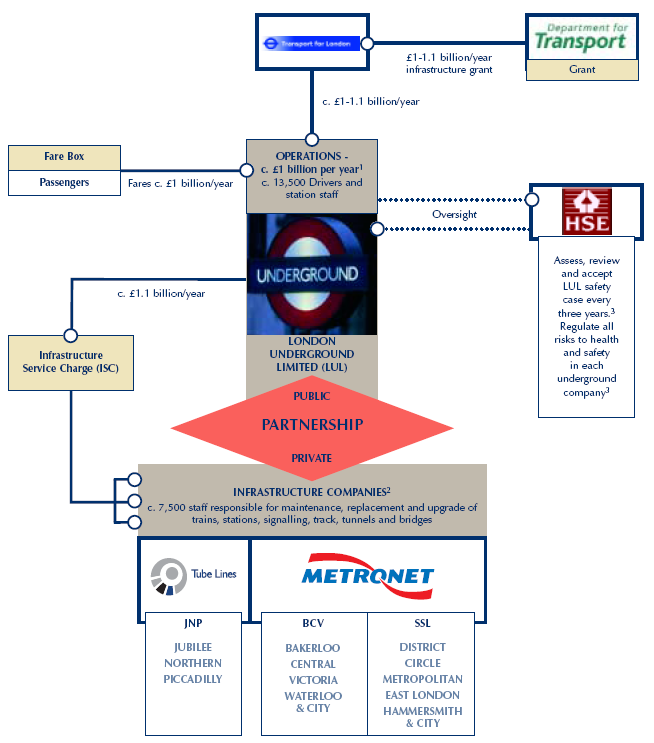
The PPP structure
5 Between June 1997 and February 1999 the Government and London Regional Transport conducted a wide-ranging debate about the future arrangements for the Tube. A number of options were analysed. The Government considered that under conventional public sector management the Tube had long suffered from under-funding and also from financial uncertainty as a result of annual public expenditure reviews. Moreover, it considered that London Underground's management of major capital programmes had been weak, leading to substantial cost and time over-runs. Yet, the Government considered that performance in operating the trains had been satisfactory and selected a structure of PPPs intended to combine:
■ stability of funding - because the private sector would raise the capital required on a long term basis;
■ private sector project management of a major infrastructure programme, in which the private sector retains an interest in the performance of the infrastructure over 30 years; and
■ continued public sector management of the train operations.
Although these goals are not inherently complex, setting out to achieve the desired outcomes through output based contracts requires the PPP structure to be sufficiently detailed and, at times, complex.
|
1 |
|
Structure of the Public Private Partnerships (PPPs) |
|
|
|
Tube operations and infrastructure are run through a partnership between three parties - LUL, Tube Lines and Metronet. They are paid through a combination of grant and farebox revenue. |
|
|
|
|
|
|
|
NOTES 1 All monetary amounts are the most recent annual figures. 2 A Partnership Director, nominated by LUL, sits on all three Infraco boards. 3 Each Infraco is also required, under the PPP agreement, to satisfy safety requirements. Source: National Audit Office |